Moses’s great boondoggle: The 1964-65 New York World’s Fair [Part I].
In 1964, Robert Moses got his last hurrah as the big builder of the Big Apple. What hath Bob wrought?
![Moses’s great boondoggle: The 1964-65 New York World’s Fair [Part I].](https://storage.ghost.io/c/cc/38/cc38d485-3f83-4ed4-95ed-586b53e0b5c5/content/images/size/w1200/2026/04/unisphere-wf-1964.jpeg)
Sixty-one years ago today, on April 21, 1965, the New York World’s Fair opened for its second season. (Tomorrow, April 22, is the anniversary of the opening of its first season, in 1964). The 1964-65 World’s Fair, most famous for the “Unisphere” design, is really a fascinating story about architecture, design, economics, history, politics and the changing world in which it occurred. When you think of the 1960s you don’t generally think of the World’s Fair as a major turning point in that momentous decade, but it has some interesting things to tell us.
The whole idea of a “World’s Fair” is rather quaint these days. While there have been World’s Fairs of varying magnitudes in the decades since 1965, some in the United States, the era of the large-scale World’s Fair like the Columbian Exhibition in Chicago in 1893 or the exhibition that sparked the building of the Eiffel Tower in Paris in 1889 is pretty much over, and the 1964-65 World’s Fair is one of the reasons why. An economic boondoggle—in fact a major disaster, money-wise—the experience established that by the 1960s World’s Fairs, always tricky propositions from an economic standpoint, were simply too expensive to create and too uncertain to return their investments to survive for very long. In that sense they’re like the Olympics: more for show, prestige and a one-time short-term boom to the place that hosts them, followed by a very long and expensive aftermath that seldom if ever has a happy ending.
The idea for the World’s Fair was born partly out of economics and partly out of nostalgia. The small circle of New York businessmen who wanted it looked back fondly on the 1939 World’s Fair, which had also been in New York, and wanted to give their children and grandchildren that same experience. It was, of course, also an opportunity to sell tickets and most importantly advertising, and bring potentially millions of visitors to the New York area. Great idea, right?
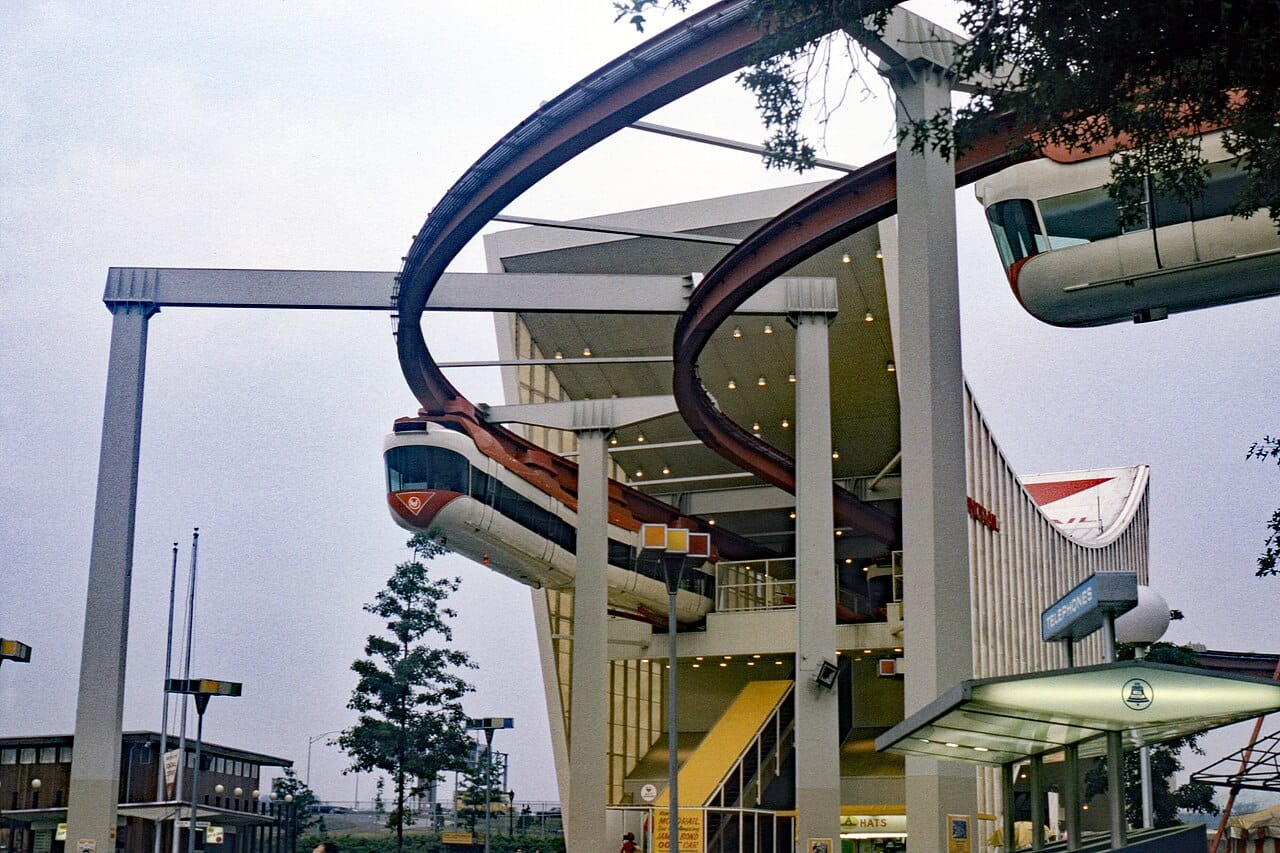
The problem was that, by 1964, the costs of building a huge world’s fairgrounds essentially from scratch—for a temporary exhibition—was pretty prohibitive. The committees that examined the question determined that the fair would need 70 million visitors just to struggle into the black. That was a pretty tall order. Then the organizers of the fair got Robert Moses involved. This one decision may well have been the fair’s undoing, before it even began.
There will probably never be another character in American history quite like Robert Moses. He was not a political leader or elected official, but he was arguably the most powerful man in New York from the 1930s to the 1960s. In his long career as an urban planner, and a person to whom political leaders listened and gave lots of money, he built freeways, parks and generally remade New York into its 20th century incarnation. Moses generally did this with little accountability to elected officials or taxpayers. He razed entire neighborhoods and displaced thousands of people at the drop of a hat. He was also quite racist, and used “urban renewal”—a euphemism if there ever was one—to prioritize urban infrastructure for the benefit of wealthy white people and the direct detriment of anyone else. Robert Caro’s towering biography The Power Broker is undoubtedly the seminal treatment of Moses and one of the best historical books of the 20th century. I need not go into that story here.
Moses’s career began in the 1920s but the heyday of his power had been during and right after World War II. By the 1960s he’d generally accumulated more enemies than friends, but he was still an immovable object in terms of urban planning and infrastructure policy. Moses was so much of a problem, in fact, that New York Mayor Robert Wagner decided the perfect way to put him out to pasture was to put him in charge of the World’s Fair. Others on the planning committee balked, but Moses got the job. It would probably be his last major planning project.
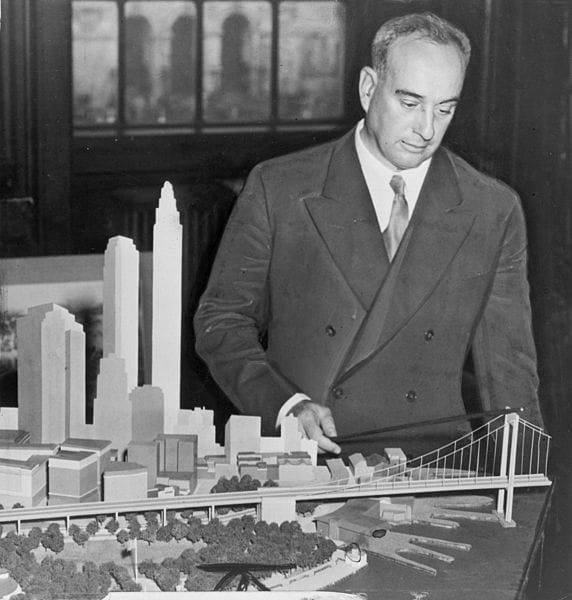
This was a golden opportunity for Moses. He’d been involved in the 1939 fair and in fact used that as a means to carry out his single most ambitious project, the creation of Flushing Meadows Park, which before 1939 was a garbage dump. The 1939 fair was held there and he decided to site the 1964 there to finish what he started 25 years earlier. Moses made a fateful decision soon after coming on the job: in order to maximize the fair’s profits he decided the fair would collect heavy rents from any companies that chose to build and open pavilions at the fair. That sounds like a bit of boring accounting business but it was hugely consequential. The Bureau of International Exhibitions (BIE), which regulated World’s Fairs in much the same way the International Olympic Committee regulates the Olympics, had a rule that prohibited this. Moses’s response to the BIE was essentially an upraised middle finger. Although the BIE didn’t sanction the 1964 World’s Fair—the U.S. was technically not yet a member of it—at least everyone thought it wouldn’t actively try to thwart it. Upset by Moses’s attitude toward them, the BIE retaliated by urging all its member nations to boycott the fair.
Several important nations did observe the boycott. Most of the British Commonwealth refused to attend, as did the USSR and the entire Soviet bloc. Several smaller countries did participate, such as Sweden, Spain, Denmark and Pakistan. In fact the Spanish pavilion was considered architecturally and artistically the highlight of the international pavilions. Belgium built a replica Flemish village, and the Japanese built a modernistic castle complete with moat and geisha girls. But, as Moses intended, most of the buildings and exhibits constructed at Flushing Meadows Park were pavilions showcasing U.S. corporations. The World’s Fair was primarily an advertising platform.
The fair almost wasn’t ready for its opening. Despite several epic PR battles—including one where Moses initially refused to allow school kids to get into the fair for reduced fees on group tours—Moses charged ahead and ultimately the fair was completed just in time. On April 22, 1964, the gates opened. Less than half of the expected visitors came the first day, partially because of bad weather. The fair had a rocky beginning but as weather improved it started to become more popular. In its first 6 weeks, 6,000,000 people visited and most of them had a great time. But there were troubles ahead, as we’ll see.
Tomorrow I’ll describe some of the specific exhibits at the fair, the financial troubles it suffered and its ignominious end. Stay tuned!
The header image for this article is by Flickr user PLCJr and is used under Creative Commons 2.0 license.
The Value Proposition
Why should you be reading this blog, or receiving it as a newsletter? This is why.
☕ If you appreciate what I do, buy me a virtual coffee from time-to-time to support my work. I know it seems small, but it truly helps.
📖 You could also buy my newest book.
🎓 Like learning? Find out what courses I’m currently offering at my website.
📽 More the visual type? Here is my YouTube channel with tons of free history videos.


Comments ()