Interiors: Entry hall of Haas-Lilienthal House, San Francisco.
This beautiful mansion, built in 1886, managed to survive the great earthquake and fire of 20 years later.
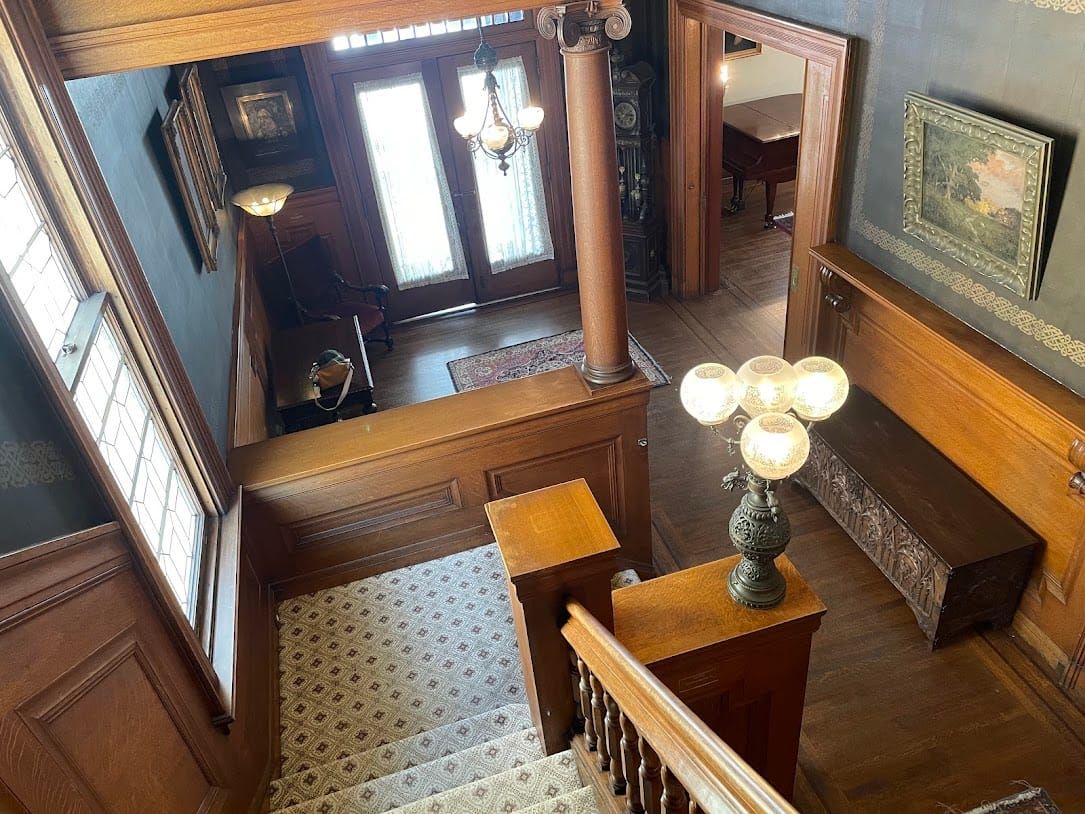
This is the entry foyer of a Victorian-era mansion known as the Haas-Lilienthal House, located on Franklin Street in San Francisco, California. I took this photo on my recent trip to that city (and it will likely be included in an upcoming video on my YouTube channel about Victorian-era San Francisco). This house is among the architectural survivors of the great 1906 earthquake and fire that leveled most of the city. Built in 1886, the house, now a museum, is a superb example of the Stick-Eastlake and Queen Anne styles. This grand entryway leads into a hallway that runs the entire length of the house, front to back, with parlors and other rooms branching off of it. This was the nerve center of the house, the first thing visitors would see when they arrived and the place where the family who lived here would encounter each other every day. It’s a beautiful and perfectly-preserved piece of the residential past among San Francisco’s upper class.
The Haas-Lilienthal House was built for William Haas, a Jewish immigrant from Bavaria who arrived in the United States at the end of the Civil War and settled in San Francisco in 1868. He joined his brothers who owned a wholesale grocery company, and the family quickly became prosperous. Haas, whose wife Bertha was born in San Francisco but was also of German extraction, was an important member of San Francisco’s “Jewish Aristocracy” in the decades before World War I. The house gets the second part of its name from the husband of the couple’s youngest daughter Alice, born in 1885, who married Samuel Lilienthal in 1909. He later took over the Haas Brothers grocery concern. Alice Lilienthal continued to live in this house until her death in 1972, after which it became a museum.
This room perfectly exemplifies the sort of wealthy domesticity that was popular in the Victorian era. There’s also a lot of the Haas family and their personalities displayed here, such as various objects from or that evoke Bavaria, their original homeland. To the left of the front door is a painting of a traditional Bavarian woman. The painting on the wall to the right is of a Bavarian forest. The wooden chest beneath that, elegantly carved, was imported from Bavaria. You can see a piano just inside the door of the parlor to the right of the foyer. The lights here would originally have been gas, but even after much of San Francisco was electrified in the 1890s, gas remained in many houses; broken gas mains, in fact, were a major cause of the fire following the April 18, 1906 earthquake. A fire break that saved this house from the advancing flames was made just across the street. Although you can’t see it in this picture, just to the left of the frame, on the wall covered in green, there’s a crack that stands as the only physical damage the house sustained during the earthquake.
I love spaces like this especially when they can connect us with the history of a place, a city and an era. The Haas-Lilienthal House certainly does that. I hope to say a few more words about it, and show you more of it, in my video on Victorian-era San Francisco which should be coming out this summer. I also plan to be showing some other San Francisco landmarks in this Interiors series. Hope you enjoy them!
The Value Proposition
Why should you be reading this blog, or receiving it as a newsletter? This is why.
☕ If you appreciate what I do, buy me a virtual coffee from time-to-time to support my work. I know it seems small, but it truly helps.
📖 You could also buy my newest book.
🎓 Like learning? Find out what courses I’m currently offering at my website.
📽 More the visual type? Here is my YouTube channel with tons of free history videos.

Comments ()