Interiors: Garden Court, Palace Hotel, San Francisco.
This is one of the central features of the grand Edwardian-era hotel, completed in 1909.
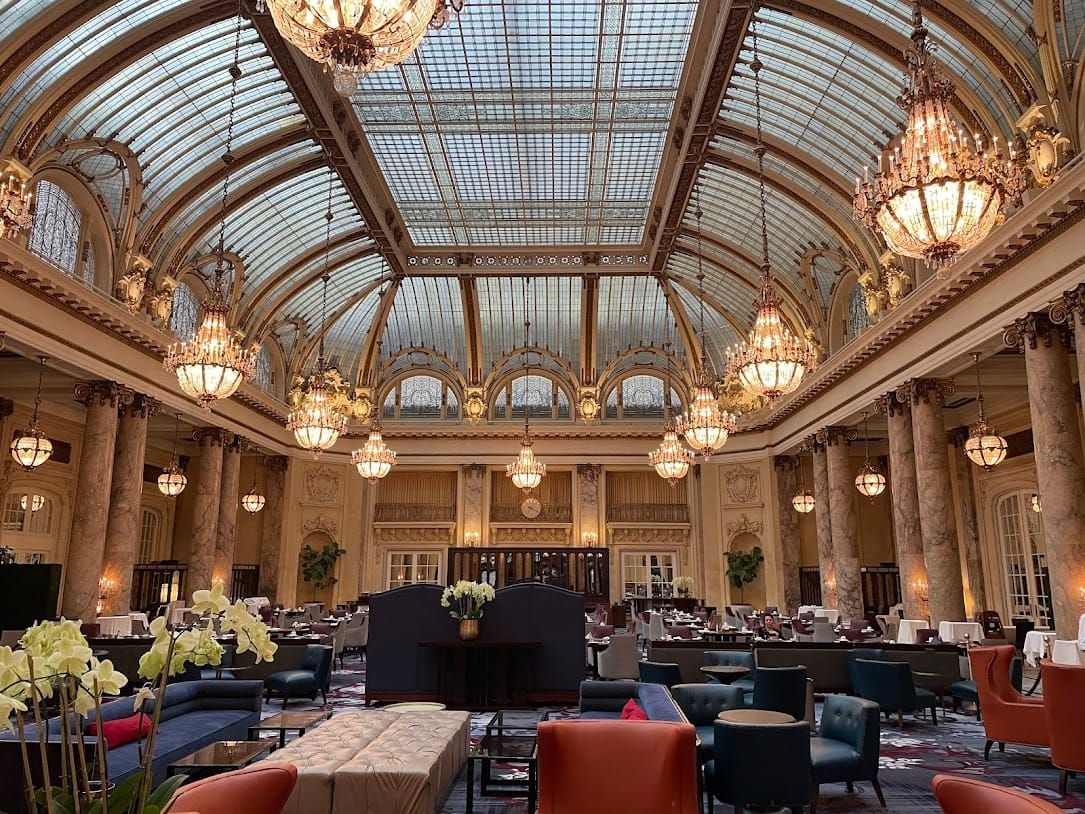
Sorry to lay another Interiors post on you so soon after the last one—however, I’m extremely busy these days, working on a new deep dive video and preparing for the launch of my science fiction book Faraway Star. This is the Garden Court, also sometimes known as the “Palm Court,” of the Palace Hotel on Market Street in San Francisco. I took this photo on my recent trip there, from which the previous Interiors post also came. I was shocked when I visited, at 7PM on a Thursday night, that aside from a lady talking on her phone (you can see her toward the lower right), I was literally the only customer in the place. But it’s an amazingly beautiful room with polished marble columns and a glass atrium, quite typical of the style of its 1909 construction date. Indeed this room has a very late-Edwardian feel to it, the last gasp of opulence before the searing experience of the First World War changed everything.
The Palace Hotel has an illustrious history. It was originally built in 1875, financed by banking and mining tycoon William Chapman Ralston. The construction of the hotel was so expensive that it ruined Ralston, whose body was found floating in San Francisco Bay just months before the hotel opened; he probably committed suicide. Instantly the premier hotel on the West Coast, the Palace was badly damaged in the April 1906 earthquake and fire and its remains were pulled down. What you see here is the result. The reconstruction of the Palace was thought to be an important symbol of San Francisco’s resilience.
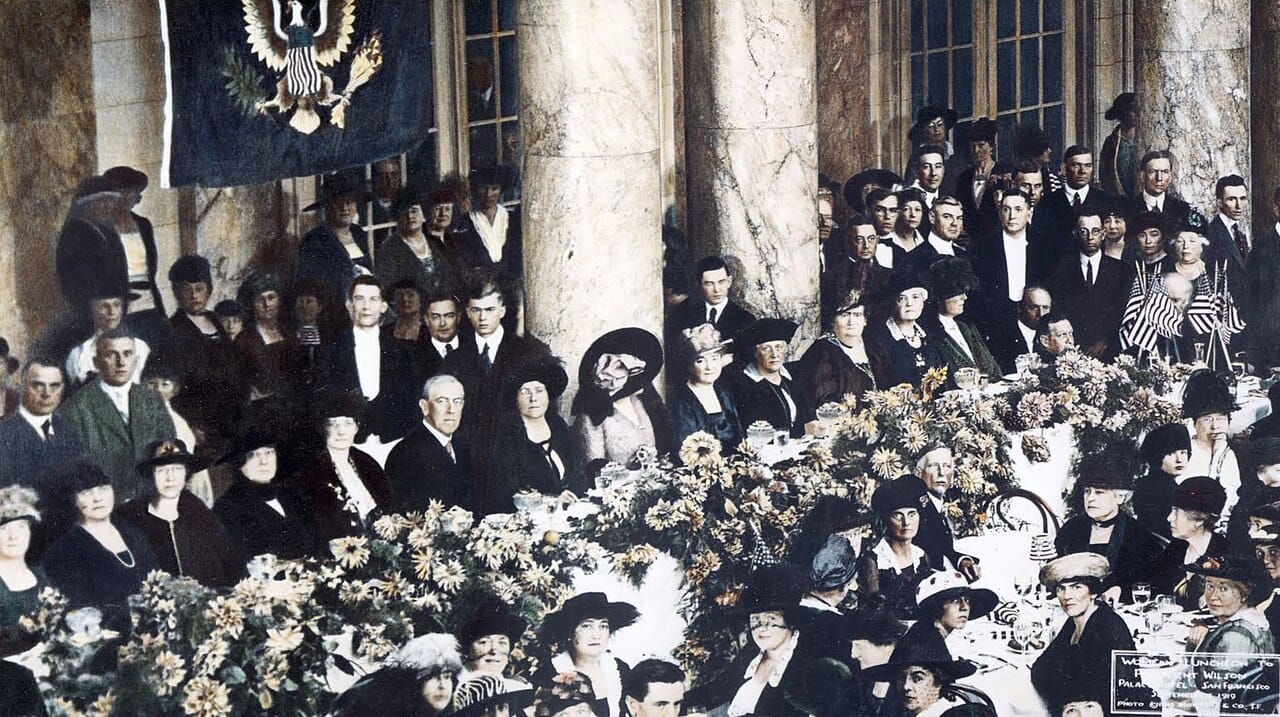
The history of the hotel in its second incarnation has been no less interesting or prominent. The photo above shows a banquet held in 1919, in this exact room, where President Woodrow Wilson held a banquet to drum up political support for the Treaty of Versailles and his pet League of Nations project. Four years later, Warren G. Harding, Wilson’s unfortunate successor in the White House, died of cardiac arrest in an 8th floor room of the Palace Hotel. The hotel later hosted events to help inaugurate the new United Nations in 1945, and Soviet premier Nikita Khrushchev was also a guest during the 1950s.
When I went to San Francisco on my recent trip I was very curious to visit the Palace. I’m still undecided whether I will include it in my upcoming video, “San Francisco that Survived,” because technically it didn’t survive the 1906 disaster. But it’s too beautiful a space to ignore. I stayed only a short while, quaffing a glass of pinot noir while waiting for my husband to join me for dinner at a different restaurant some distance away. Because I was only one of two customers in the place, the wait staff was quite attentive. I wonder if grand spaces like this, so important in the Edwardian era and the 20th century, are starting to lose their popular appeal. This place should have been hopping when I was there but it was virtually deserted. The fact that most San Francisco attractions have priced themselves out of the reach of all but very wealthy people (I’m not one of them; remember, I only had one glass of wine) probably doesn’t help.
You’ll probably see more from San Francisco in the Interiors series soon!
The Value Proposition
Why should you be reading this blog, or receiving it as a newsletter? This is why.
☕ If you appreciate what I do, buy me a virtual coffee from time-to-time to support my work. I know it seems small, but it truly helps.
📖 You could also buy (preorder) my newest book.
🎓 Like learning? Find out what courses I’m currently offering at my website.
📽 More the visual type? Here is my YouTube channel with tons of free history videos.

Comments ()