Four minutes of enlightening darkness: The great solar eclipse of May 1715.
Correctly predicted by Edmond Halley, the eclipse was visible proof of the power of scientific thought.
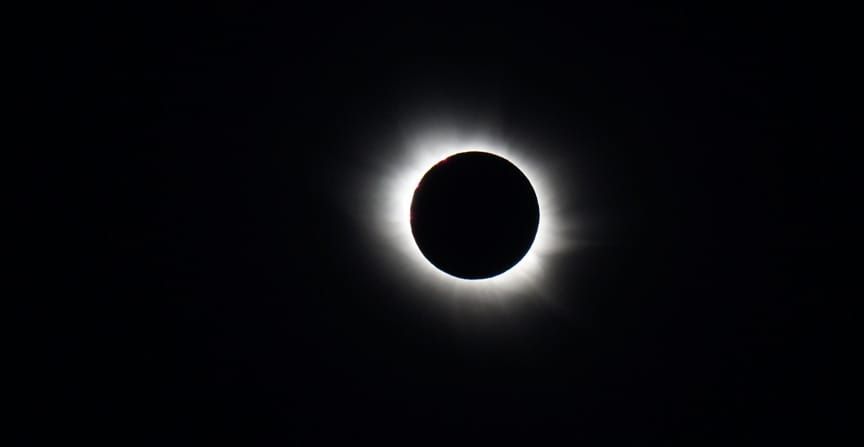
Three hundred and eleven years ago today, on May 3, 1715, the skies began darkening over England at about 9:30 in the morning. A rare total solar eclipse occurred, blocking out the sun’s disc completely. The period of darkness lasted from three to four minutes in most places. In London, where thousands of people looked skyward to see the sight—warnings about not looking directly at an eclipse weren’t common then as they are today—the period of darkness lasted 3 minutes, 33 seconds. Most of northern Europe, including Holland, the Scandinavian countries and Russia, fell into the shadow of the eclipse. Given that the weather was good across Europe that day, the 1715 eclipse was one of the most spectacular astronomical events of the early modern period.
One of the many people who observed the eclipse that day in London was Edmond Halley, the noted British astronomer, inventor, explorer and later the Astronomer Royal of Great Britain. The eclipse held special significance for Halley because he had predicted it, using the same sort of mathematical analysis and astronomical observation with which he correctly predicted the return of the comet that bears his name, which was last seen in 1986. Halley understood the motions of stars and planets better than almost anyone in Europe at the time, and almost anyone in the world since the age of the great astronomers of the medieval Arabian civilizations. Halley’s computations were so precise that he came within four minutes of predicting the exact time of day the total darkness period would occur.