“The Odyssey” and “Backrooms”: Reclaiming cinema in 2026.
Two fascinating current films have left me with some optimism about where cinema of the 2020s may be headed.
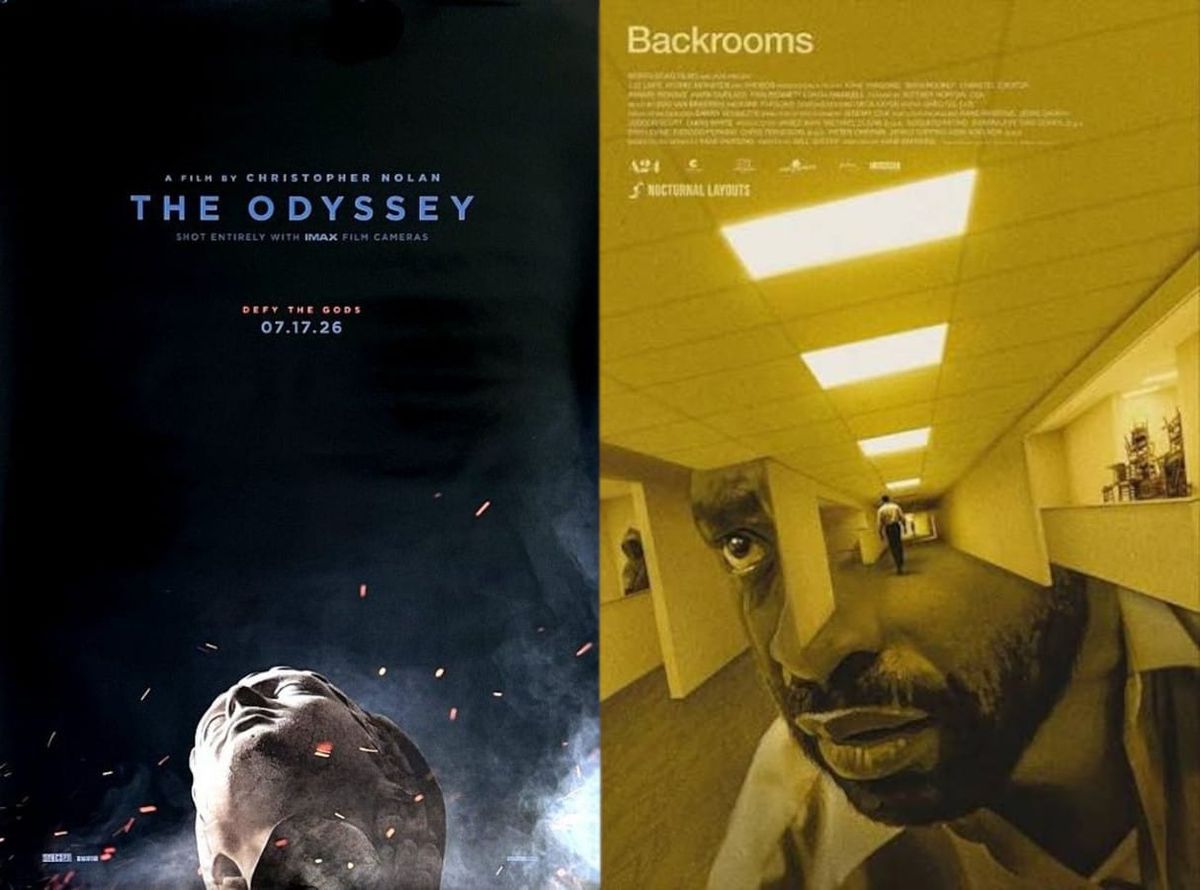
I’m a cinephile, as you probably know from the many articles I’ve done on old movies, but I very rarely keep up with “current” films, in the sense of newly-released pictures that are presently in cinemas or hot on streaming. It usually takes me many months or even years to see a new film. Thus it’s a very rare occasion that I can comment on films in a more or less topical way. But, just this past weekend, in fact on the same day, I saw two pictures that I expect will turn out to be pretty important in American cinema in the year 2026: The Odyssey, the Greek war and mythological epic directed by Christopher Nolan, and Backrooms, the quirky horror indie by first-time director Kane Parsons. This article presents my thoughts on both of them, with the uniting thought that, for the first time in quite a number of years, we seem to be in the midst of a very good year for films. In fact, after being down for the count for more than half a decade, there might be signs in 2026 that the medium of cinema might, just might, be headed for a resurgence.
There’s been a lot of discourse online about The Odyssey, and much of it, at least the part I’ve seen, has been from classicists, historians or others uniquely knowledgeable about the source material. I am a historian, obviously, but ancient Greece is not my forte, and I haven’t read The Odyssey in many years. So I’m coming at it mostly from the perspective of a casual everyday moviegoer. I generally found the film to be pretty good. Not groundbreaking, not a masterpiece for the ages, but pretty good. What does strike me as extremely positive about it is that it demonstrates the oldest stories in our culture, and literary “properties” that seem at first glance to belong mostly to the aforementioned learned specialists, can still attract and enthrall modern popular audiences. People have been telling each other the story of Homer’s Odyssey for 3,000 years. Now, in an era when the powers-that-be, at least in America, are trying to kill off literature, the arts and humanities disciplines as quickly as possible, something from that milieu has made (as of this writing) $684 million and demonstrated its cultural relevance in no uncertain terms. Whatever The Odyssey’s merits as a motion picture, I think we have to thank Christopher Nolan for that.
The Odyssey is, of course, the story of Odysseus, played by Matt Damon. A battle-hardened commander, he and his men are taking a rather roundabout route back home in the aftermath of the Trojan War, whose climactic battle was the sacking of Troy. We all know that story. It seems to me the main problem with adapting The Odyssey to modern film is that it quickly becomes merely a series of loosely-connected episodes, especially the encounters with mythological monsters like the Cyclops, the part everybody remembers. As charming as the Coen Brothers’ comic 2000 adaptation O Brother, Where Art Thou is, it suffers from that problem. In the 2026 version Nolan at least attempted to string together Homer’s episodes into an emotionally and narratively cohesive whole. The theme has to do with trauma and war, and the deliberate breaking of social norms and moral codes, or something like that. As a historian I very much liked that Nolan tied that theme explicitly to the Bronze Age Collapse, which is a topic you don’t hear discussed very often in popular movies these days. I’m not sure the film entirely succeeds in elucidating that premise coherently, but I definitely appreciated the attempt.
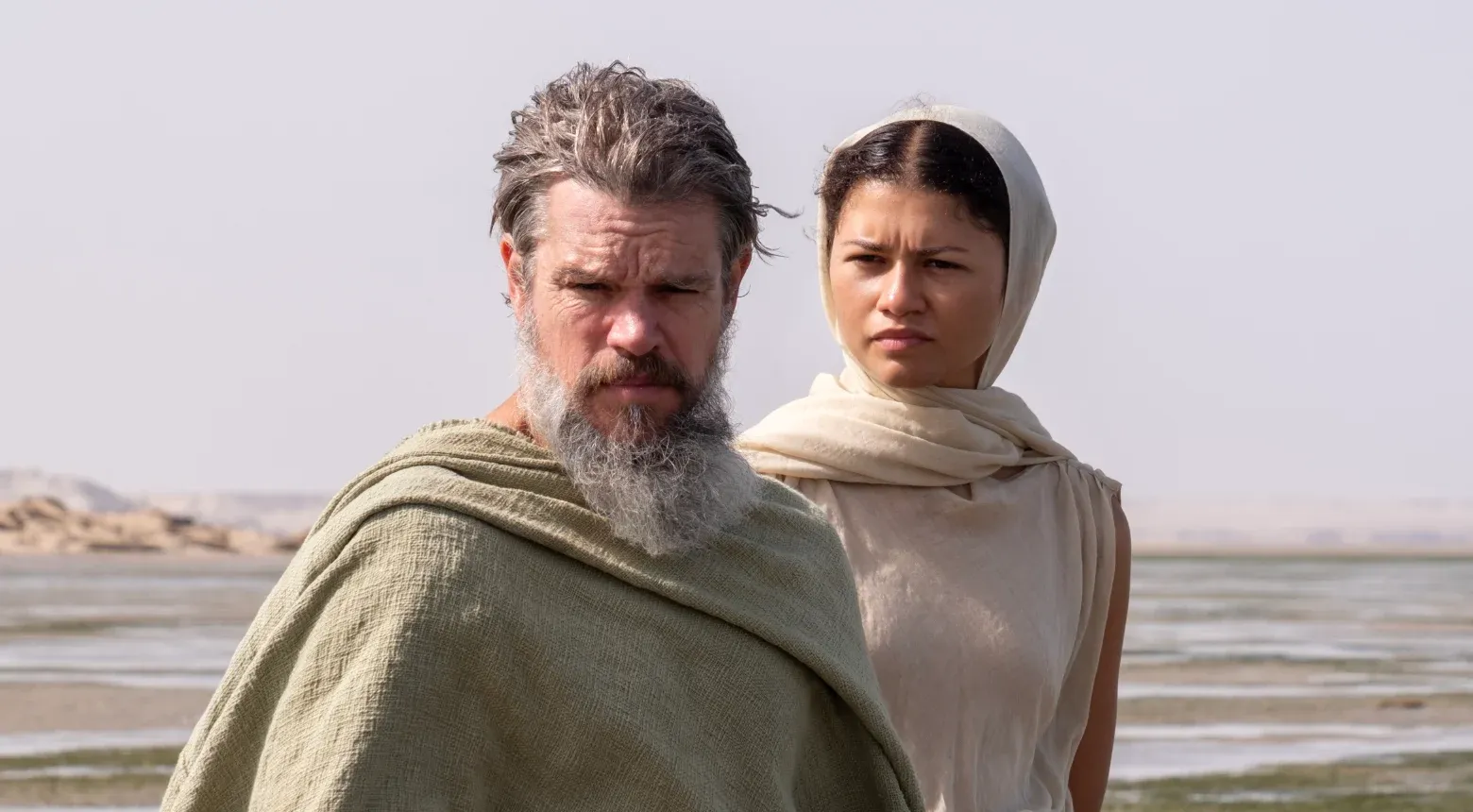
As a film, The Odyssey is well-made, entertaining and spectacular. Even though it comes more from Virgil’s The Aeneid than Homer’s Odyssey, I did like the way the film depicts the Trojan Horse and its role in the sack of Troy. Matt Damon is a perfectly acceptable Odysseus and the supporting cast, including Anne Hathaway, Elliot Page and (surprisingly) John Leguizamo, is excellent. The film does suffer from some of Nolan’s deficiencies and blind spots as a director. Harking back to one of the problems with his (to me) dreadful Batman pictures, he still apparently likes to shoot action sequences in what I call “Confuse-O-Vision,” a lot of split-second cuts, action lurching across the screen in too many directions, and many shots done in such impenetrable darkness that it’s difficult to know what’s going on at any given moment. And, a problem I noticed in his 2023 film Oppenheimer, which I generally liked, the sound mix in The Odyssey is terrible. Music is way too loud in many sequences, and key dialogue way too soft. And would it kill him to turn up the lights on some of his actors from time to time, so we can at least see their faces clearly in the night scenes?
As good as The Odyssey is, I don’t disagree with those—my husband, for instance—who have said that they sense a sort of emptiness in the picture, the lack of something more substantial that should be there at its core but really isn’t. The fact that two paragraphs ago I had trouble summarizing the theme of this film is definitely a hint that something is amiss with it conceptually. What lesson are we to draw from Nolan’s interpretation of The Odyssey? That war is hell and people often come to regret what they do during war? I think it’s more complicated than that, but I’m not sure what else he’s trying to get at, though I can make some educated guesses. There does seem to be a narrative and conceptual muddiness here. If in an alternate universe we’d ever gotten the chance to see David Lean’s The Odyssey with screenplay by Robert Bolt, or Steven Spielberg’s The Odyssey with screenplay by Tom Stoppard, I don’t think we’d have as much trouble discerning whatever those directors’ takes on the material might have been. So there clearly is something missing. But on the whole, I liked it.
Although they’re entirely different sorts of pictures, I have to say that I liked Kane Parsons’s Backrooms even more. I saw this at home on our not-so-small screen, a couple of hours after my eardrums returned to normal from Nolan’s aural assault, and I was swept up in this strange little picture instantly. Backrooms is the story of a down-on-his luck architect, Clark (Chiwetel Ejiofor), who runs a furniture store in California and who is occasionally in therapy with his bland analyst Mary (Renate Reinsve). Investigating some electrical anomalies in the store, Clark walks through an invisible wall and finds himself in a bizarre liminal space, wallpapered in pale yellow and with beige carpet, that stretches into infinity behind his furniture store. Corridors branch off at crazy angles, doors lead nowhere, and there are disturbing distant echoes and screams of people who may (or may not be) suffering some terrible torment. Clark’s exploration of the space eventually pulls Mary in, and both encounter strange and imperfect facsimiles of their own neuroses, nightmares and human frailties.
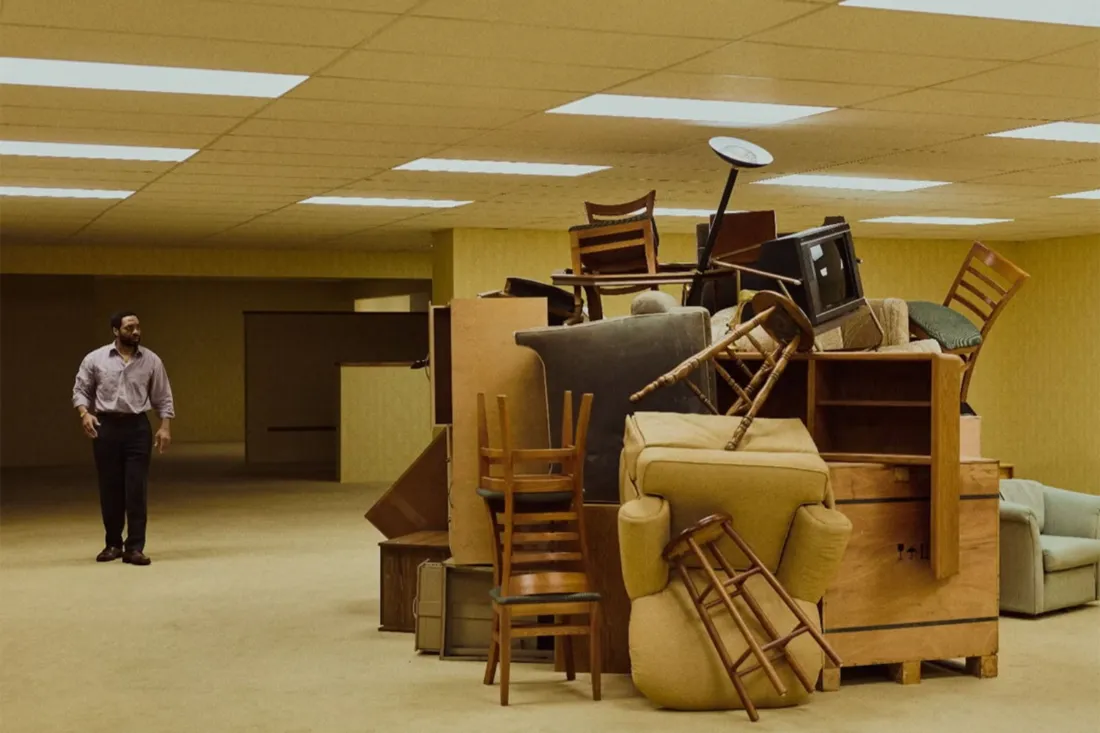
Backrooms, the first feature film I know of based on an internet meme, is so exciting because it’s an example of something vanishingly rare in cinema these days: something you’ve never seen before. Parsons utterly refuses to traffic in conventional tropes or traditional storytelling beats, but neither does he violate them simply for the sake of violating them. Backrooms does not have a standard plot and everything that happens onscreen is totally surprising, yet logical within the story as it develops. It could easily have become a boring monster movie or slasher, with the menace in the creepy-looking liminal space turning out to be another miscreant in a mask wielding a knife. It absolutely is not that, and is so far away from that sort of conventional construction that the film hits like a blast of fresh air. This is what good movies are supposed to do! They’re supposed to show us things we’ve never seen before, stories we don’t anticipate, and make us think about things we didn’t know we should be thinking about. That Backrooms is scary without being gory, unsettling without being offensive, and quirky without being self-important is a major achievement. Kane Parsons, by the way, is 20, slightly older than my nephew. If nothing else, Backrooms will go down in cinema history as one of the great debut films of all time.
Given the pictures that have been coming out over the past decade or so, I was beginning to lose faith that cinema in 2026 was capable of giving us something like either The Odyssey or Backrooms. The film business was knocked for six by the COVID-19 pandemic and its recovery since 2021 has been stymied by the chaos of consolidation among studios in the streaming era, and the tragically corrosive effect of AI on all creative endeavors. Now that we seem to be—finally, mercifully!—emerging from the cinematic dark age in which all studios ever seemed to want to give us were obnoxious CGI-sodden franchise pictures where knobby hypermuscled superheroes fling each other into skyscrapers, it’s time for real directors like Nolan and Parsons, imperfect as their visions might be, to be allowed to step up to the plate and show us something substantive and worthwhile. It’s much too early to call 2026 a renaissance of cinema, especially on the basis of only a few films that have proven popular, but I think there’s room for hope. If nothing else, you could do worse with a couple of hours than to watch The Odyssey and Backrooms.
The Value Proposition
Why should you be reading this blog, or receiving it as a newsletter? This is why.
☕ If you appreciate what I do, buy me a virtual coffee from time-to-time to support my work. I know it seems small, but it truly helps.
📖 You could also buy my newest book.
🎓 Like learning? Find out what courses I’m currently offering at my website.
📽 More the visual type? Here is my YouTube channel with tons of free history videos.

Comments ()