Killing books: The sack of the University of Louvain library and its modern echoes.
In 1914, the Germans torched one of the great libraries of Europe. AI companies are doing something similar today.
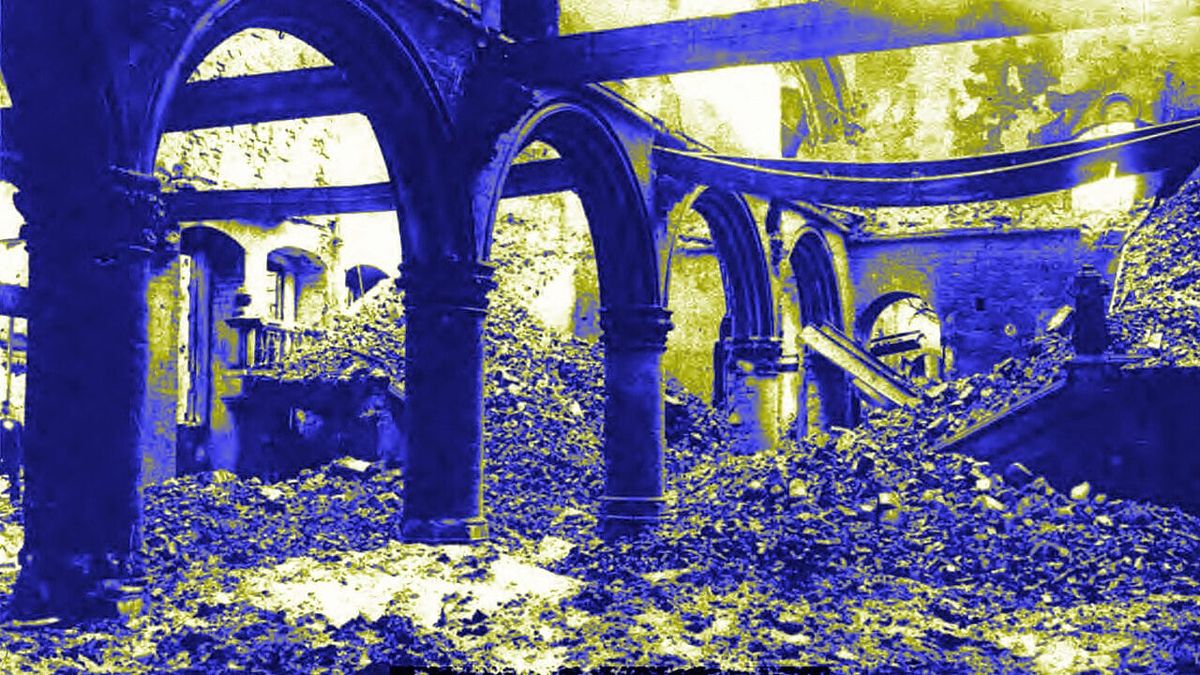
One hundred and twelve years ago this week, on August 25, 1914, an unspeakable tragedy in world culture occurred in a small corner of Belgium. On that day German troops, which had recently occupied the city of Louvain—also known as Leuven—set fire to the library on the campus of the Catholic University of Louvain. Over 250,000 rare books were destroyed, many of them dating back to the Middle Ages. These illuminated manuscripts were one-of-a-kind items, totally irreplaceable. Among them was the Dresden Bible, the earliest complete Bible in any Slavic language (Czech), compiled in the late 14th century. A great deal of material had been amassed at the University of Louvain library documenting the religious struggles of Belgium and Holland during the Protestant Reformation. There were also some of the very first printed books, dating from the 1470s, and materials from farther afield, such as a rare wooden tablet of hieroglyphic-like writing that was discovered on Easter Island in the 19th century. The truth is we don’t know everything that was lost at Louvain, because the University was in the process of cataloging its holdings, and that audit was not yet complete at the time of the German attack.
This tragedy can be classified as an act of libricide: the deliberate destruction of books and knowledge. The word libricide literally means “killing books.” Libricide can take many guises and be used for many purposes, all of them pernicious. It can be an act of authoritarian control, such as the mass burnings of books in Germany when the Nazis came to power in 1933. It can be religious in nature, such as the suppression of the writings of Arius in the early Eastern Roman Empire, or high-profile public burnings of the Quran by American fundamentalist Christians in this century. It can also be a tactic of war, as it was in the Louvain case, or again when priceless books and many other treasures were looted from Baghdad’s universities and museums in the 2003 American invasion of Iraq. The killing of books usually goes hand-in-hand with the killing of human beings. It is not a trivial crime.
Why did German troops destroy the University of Louvain? The answer seems to be as unclear in 2026 as it was in 1914. Germany invaded Belgium in early August 1914, an act that led to the full-scale outbreak of World War I. After Belgian forces pulled out, the German Army occupied Louvain more or less peacefully for about a week. But then on the night of August 25, a fire broke out at the University. Some say it was set by drunk German troops who wanted to see a building in flames. There were evidently some claims of “military necessity,” though it’s hard to see what sort of military threat an ancient building full of books presented. It’s also possible the fire broke out accidentally. As Tolstoy argued famously in War and Peace, a foreign army occupying a sizable city is an extreme fire hazard by its very nature.