The Truce of 1914: A thought of hope for Christmas.
The famous World War I Christmas Eve truce still has lessons for us today on how to imagine a better world.
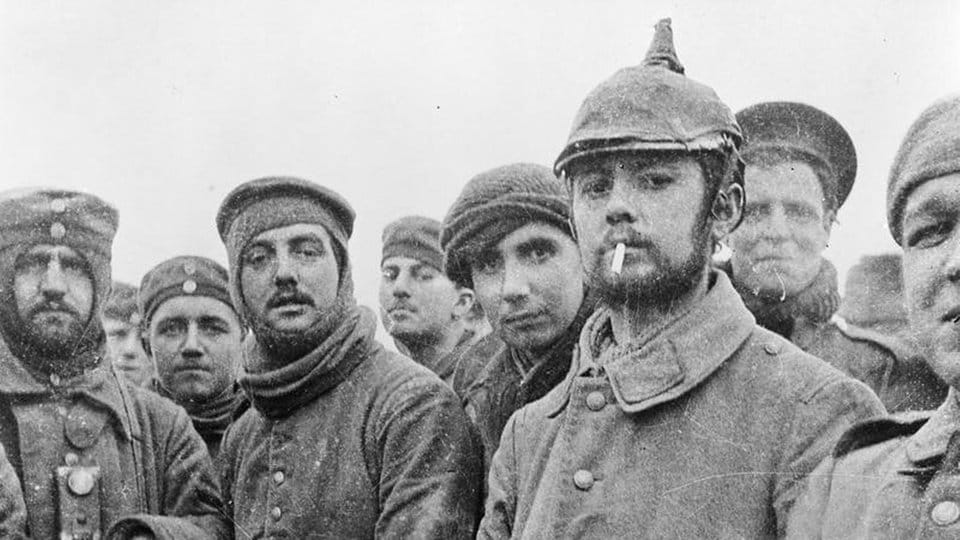
Tomorrow is Christmas Eve. In the past I’ve written on the various incarnations of my blog about the famous Christmas Truce of 1914, when troops on the battlefronts of the First World War declared informal cease-fires and fraternized with one another—unbidden and unsanctioned by their commanders—on the occasion of the holiday. While the Christmas Truce happened on several battlefields involving various nations, by far the most famous was on the Western Front between British and German soldiers, in which as many as 100,000 men might have participated. The classic photo in the header of this article was taken on Christmas Day, 1914. You can tell it’s early in the war because the German soldier is still wearing a “pickelhaube,” or spiked helmet. These were phased out in 1916, replaced with the “Stalhelm,” the more familiar classic German helmet shape that was also used in World War II, which the British sometimes called the “coal scuttle” helmet.
The Christmas Truce has attained almost mythic status in historical memory, and is perhaps asked to support more meaning than it can bear. Supposedly it’s the last spark of decency and humanity before the horror and ugliness of modern warfare and its soul-destroying hatred took over completely. It’s not that. Many soldiers in World War I throughout the conflict protested it in small and not-so-small ways, such as the mutiny of the French Army in April 1917, not to mention the wholesale refusal to continue the war by the entire country of Russia after the Revolution broke out the same year. World War I was horrible and tragic, and it’s probably good that we remember the Christmas Truce as a contrasting element in the sea of nihilistic brutality that the war represents. But it shouldn’t blind us to a fact that most of us know to be true: there are, in any era, still many good and decent people in the world, and it’s hard to keep them down regardless of circumstances.
Let’s keep that thought in mind as we go into the Christmas holidays of 2025. There is much to lament in our contemporary world, from the abuses of the neofascist regime of the lunatic Donald Trump, to the ominous rising tides of war in Europe, the ongoing genocide in Gaza, and hatred against women, trans people, immigrants and many others. Things may be not quite as bad as they were in 1914, but we can and should today, as those people did 111 years ago this week, continue to express our humanity, decency and hope for a better world. If this is not the meaning of the holidays, I don’t know what is.
Whenever I see the photo above I think of the German soldier with the cigarette in his mouth. He seems to be just a kid. Did he survive the war, I wonder? Did he have children, grandchildren, great-grandchildren who might be alive in Germany today? Or was he one of the millions of casualties whose lives were senselessly terminated long before their prime? I’d like to think he got out of the charnel house of the Western Front and lived a long and prosperous life. Hopefully he had many more Christmases to come. Whether he did or not he still speaks to us from this photo, bidding us to remember that there’s more that unites as as people than divides us. It’s a hard thought to keep in mind sometimes, but a good one to recall on Christmas Eve.
The Value Proposition
Why should you be reading this blog, or receiving it as a newsletter? This is why.
☕ If you appreciate what I do, buy me a virtual coffee from time-to-time to support my work. I know it seems small, but it truly helps.
📖 You could also buy my newest book.
🎓 Like learning? Find out what courses I’m currently offering at my website.
📽 More the visual type? Here is my YouTube channel with tons of free history videos.


Comments ()