The Poseidon phenomenon: Thoughts on a New Year’s Eve disaster that never was.
Had the events of the 1972 film occurred in real life, the Poseidon would be the most famous cursed ship in history.
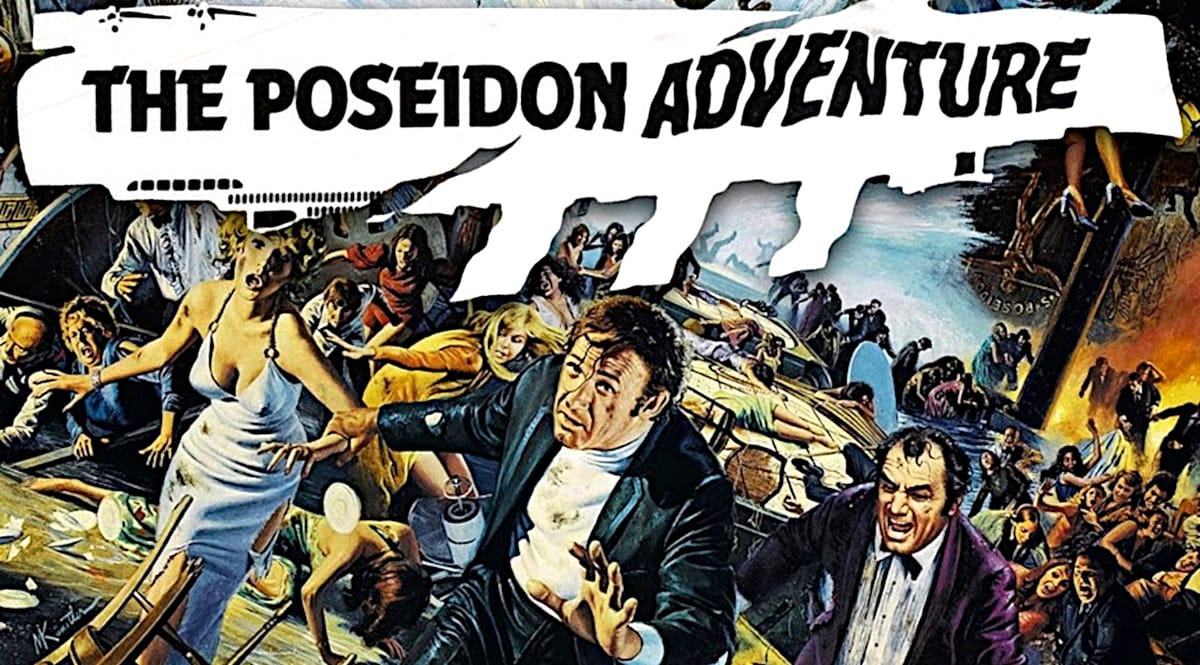
Christmas is over, but we’re still in that strange nether-zone of time between Christmas and New Year’s. This is a confusing period where work is disrupted (or absent entirely), relatives are still here or perhaps just left, and holiday leftovers remind us of the great food we had on the holiday itself. I think I’ve said quite enough on this blog about Christmas movies, but there are what you might call “New Year’s movies” whose time for traditional annual watching is coming. The Apartment from 1960 is possibly the pinnacle of that genre, but another prominent one is the 1972 disaster film The Poseidon Adventure. As that film depicts both an ocean liner and a maritime disaster associated with said ocean liner, if you know anything about me and my interests you could expect that I have a particular relationship with this film and its source material. So, on this occasion, three days before New Year’s Eve, I’m going to write about it.
Most people know The Poseidon Adventure from the 1972 film, but the movie is actually only a part of a much wider pop culture phenomenon. It was based on a novel published in 1969 by Paul Gallico, one of America’s most interesting popular writers during the decades of his prominence. I’ll say more about him and the story’s origin in a moment. If you’ve seen the film you know the story. The SS Poseidon, an antiquated old ocean liner that looks suspiciously like the original Queen Mary, is sailing through the Mediterranean on New Year’s Eve when she is capsized by a huge wave caused by an undersea earthquake. A group of survivors, gathered in the dining saloon, remain alive, and a handful of these, led by the headstrong Catholic priest Reverend Scott (Gene Hackman), decide to climb upward through the ruined ship to reach the bottom, now above water, hoping to increase their chances of rescue. It’s almost hard to get one’s head around how popular The Poseidon Adventure was upon its initial release. It raked in $125 million at the box office, the equivalent of $954 million today, which puts it in the Star Wars and Marvel universe blockbuster category. In no small part due to its unabashed corniness and 1970s campy charm, it has emerged as a significant cult object in the decades since.
Interestingly, Poseidon is pegged to the Christmas-to-New-Year’s time frame by its original source material. In the novel, the disaster occurs on December 26, Boxing Day. The film changes it slightly and the producers couldn’t resist the kitsch of having the capsize occur literally moments after midnight on New Year’s Eve. I’ve read about, written about and made videos about a number of real-life maritime and ship disasters, so I’d like to think I know a bit about them. If this disaster occurred in real life, particularly as it’s depicted in the 1972 film, it would be one of the most lethal maritime disasters in history, at least in peacetime, and Poseidon would be synonymous with the word Titanic as shorthand for a mass-casualty ocean tragedy. The film doesn’t tell us how many passengers were aboard, but (spoiler alert) it is clear how many survivors there are at the end: only six, rescued from the stern area near the propeller shaft. The novel is slightly more realistic, as it mentions that in addition to the Scott-led group, a number of survivors are taken off from the bow area. In the film, the core characters pass the larger group headed for the bow but are told at the end that these people didn’t make it.