My history with a tragedy: How TWA Flight 800 taught me about critical thinking.
My own history with the terrible 1996 tragedy is a complicated and difficult one.
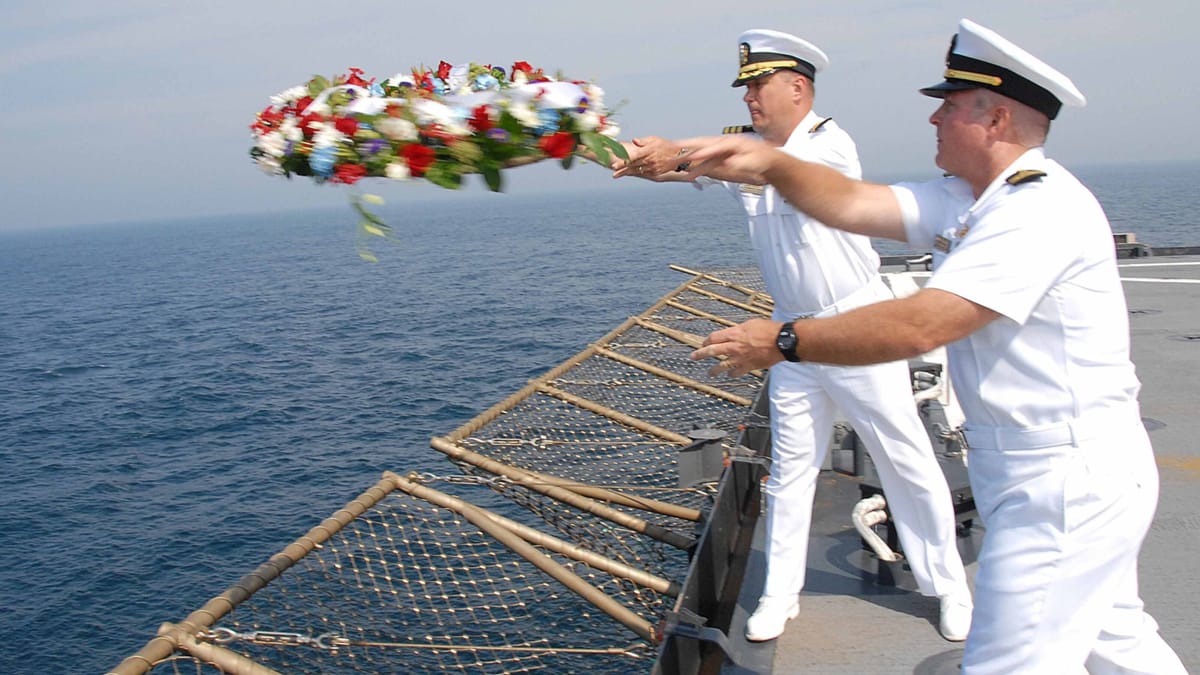
A few months from now, July 2026, will be the 30th anniversary of a tragedy that seems to stick in many people’s minds more than some others. On July 17, 1996, a 747-131 jet owned by Trans World Airlines, designated Flight 800, took off from New York’s JFK Airport headed for Paris. Shortly after takeoff the plane exploded in midair and the wreckage fell into the sea off the southern shore of Long Island. None of the 230 people on board survived. For days—weeks, in fact—the headlines were full of stories about TWA 800. There were constant heartbreaking reminders of the disaster, such as the ghastly image of people’s burned shoes washing up on local beaches. A formerly unknown place name, East Moriches, was burned into my memory that summer. I can recall few events before 9/11 that commanded the attention of so many ordinary people for so long.
Two days ago, on my channel I published my latest deep-dive history video, “TWA: The Rise & Fall.” As is customary I also did a companion piece on this blog (at the paid tier) which is here. In the video naturally I had to tackle the subject of Flight 800, probably the most well-known disaster in the 71-year history of the airline. In fact I devoted the video’s longest chapter, at over 18 minutes, to the story of Flight 800. There are reasons, both historical and personal, why I chose to do so, and in this article, which you could see as sort of a companion piece both to the video and my previous article on it, I thought I’d talk about them. TWA 800 is a very personal tragedy for me. It also lies at a curious juncture in my own intellectual and historical journey. In talking about those aspects I do not mean to minimize or downplay the tragedy and loss suffered by the many, many people who lost loved ones and friends in the disaster. My heart goes out to them, in no small measure because for a brief time I thought I was going to be one of them. That’s the entry point into my own experience with the TWA 800 story.
I was 24 in 1996 and at the time of the disaster I was between my first and second years of law school. As it happened, a friend of mine who I went to high school with—let’s call him Charlie—was traveling to Europe, specifically Paris, that summer and in fact on the very same day, July 17, 1996. He was intending to meet another mutual friend of ours who was touring France that year. On the evening of the disaster, as CNN and the rest of the news was full of it, I got a phone call; I think it was from my parents, but not entirely sure. Apparently Charlie’s parents had been notified that there was a possibility that he had been on TWA Flight 800. He was traveling to Paris that day, through the same airport, JFK, and while he was not originally booked on the flight, evidently he had been bumped from his intended flight and transferred at the last minute to a different one. It might have been TWA 800 but no one knew for sure and no one had heard from him. There was no definite word as of yet. This was still in the early hours before a confirmed list of casualties was compiled.
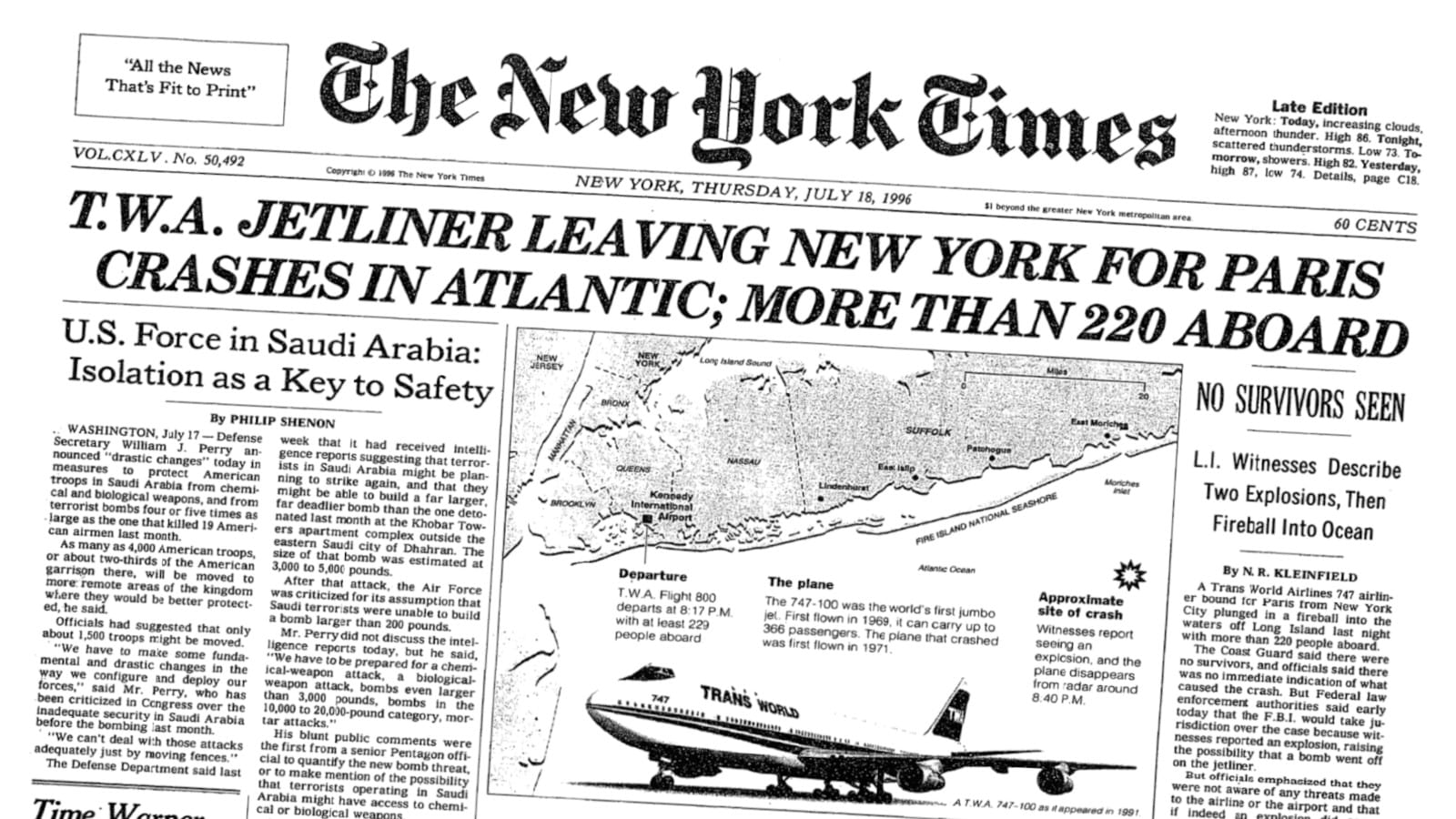
For about 24 hours we were in limbo as to Charlie’s status. I remember feeling terribly apprehensive and at one point certain that he was dead. The news was full of speculation about terrorism. When it happened, TWA Flight 800 at first resembled the awful tragedy of Pan Am Flight 103, from December 1988, which had been blown up over Scotland by a terrorist bomb hidden in a radio. The FBI was called in to the Flight 800 investigation almost immediately and word was already circulating about witnesses to the crash having seen a “streak of light” associated with the event. That it was terrorism was a perfectly reasonable suspicion to entertain in 1996. Geopolitically the disaster fell in that strange nether-zone between the Persian Gulf War and 9/11, when Americans knew they were targets but before we had the collective experience of having been attacked on our own soil. And TWA 800 occurred only 15 months after the Oklahoma City bombing. My concern for Charlie was mixed with (perhaps premature) outrage that, if he was a casualty, someone may have murdered him.
About a day or so after the disaster another phone call came. Charlie had called his parents from Paris. He was perfectly fine and enjoying his vacation. He wasn’t on Flight 800 and in fact didn’t even know about the disaster until his parents told him, on that call, that it happened and everyone was worried. Turned out he was shunted to a different flight that left shortly before Flight 800 took off. Everyone was quite relieved of course and Charlie himself shrugged off the incident. But it stuck in my mind as a disturbing near-miss with tragedy.
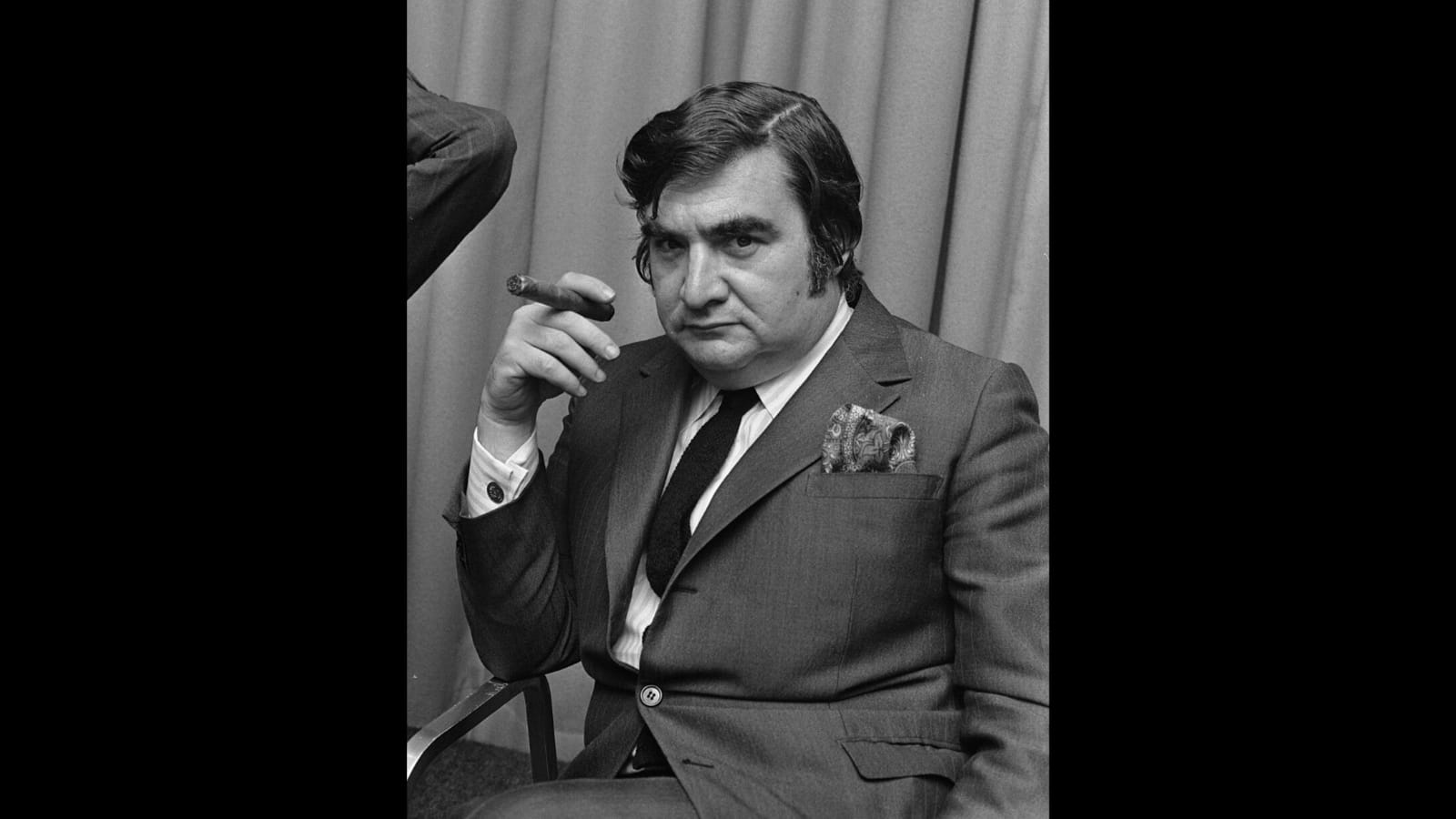
In the fall of 1996, while the investigation of the disaster was still in its early stages, Pierre Salinger, a minor news media personality, threw gasoline on the already-smoldering fire of conspiracy theories about TWA Flight 800. Salinger was not an investigator of any kind. Though he’d once briefly sat in the U.S. Senate as a fill-in appointment, his fame was largely built on his previous career as White House Press Secretary to Presidents Kennedy and Johnson. Salinger irresponsibly gave a press conference in which he trumpeted that someone had sent him “proof” that TWA Flight 800 was brought down by a missile. Salinger, age 71 when this happened, had gotten this “proof” in the form of an email forward from someone he thought—erroneously—was a French intelligence agent. These were the early days of the internet, before its propensity to amplify disinformation and conspiracy theories was well-known. The term “Pierre Salinger syndrome,” meaning the belief, especially among older people, that everything you read on the internet is true, was coined following this incident. It was really an unfortunate episode.
In marked contrast to where I am today, in the late 1990s I was easily baited by conspiracy theories. I had seen Oliver Stone’s ridiculous film JFK in theaters in 1991 and I remember coming out of the auditorium thinking, “Well, he definitely solved it—that’s obviously what happened.” Despite being a history major I had at that time not done any deep reading into the Kennedy assassination. I learned to use the internet particularly during law school, where the law review office had network-connected computers all loaded with Netscape. Because of the near-miss experience involving Charlie I took special interest in TWA 800, and naturally I came to believe the conspiracy theories maintaining that the plane was shot down by a missile. Pierre Salinger’s statements seemed to legitimize the whole thing. I remember telling someone, in fact during a discussion that took place in the law review computer lab, that it seemed clear to me that TWA Flight 800 was accidentally shot down by a U.S. Navy ship, and the government covered it up to avoid embarrassment and liability. I was angry about it, but angry in sort of a passive way, like, “Well, that’s another terrible thing the government has done,” along with Watergate, the overthrow of Mossadegh in Iran in 1953, the Tuskegee syphilis study and countless other examples of government wrongdoing. At this time I knew little about the pathology of conspiracy theories and was unaware of their uncomfortable proximity to racist and particularly antisemitic ideology.
In reality, the investigations of TWA Flight 800 were on two parallel tracks, but this was generally unnoticed by the public. Those in the know suspected immediately that the 747 may have been brought down by an explosion in the center wing fuel tank. I didn’t know until I began the research for my TWA history video this year that there were at least 25 previous accidents of this same nature recorded since 1959. Several of these led to catastrophic explosions and loss of life. The National Transportation Safety Board was painstakingly reconstructing the pieces of Flight 800 that were fished from the bottom of the ocean near Long Island and assembled in a warehouse. Forensic investigators spent most of the late ‘90s peering into spectrometers to examine minute holes in pieces of wreckage. In the meantime, the FBI and other agencies were still looking into the possibility of terrorism. Those investigations led nowhere. They put together every conceivable bit of radar data from the New York area and found no radar returns that showed any blips intersecting TWA 800’s flight path. They verified the nearest U.S. Navy ship was miles away and wouldn’t have had weapons armed anyway. There was simply no evidence of a shoot-down, whether accidental or intentional.
Indeed, how could a thing like that logically have happened? In my mind, when I believed in the conspiracy theories I assumed the TWA 800 thing was similar to another air disaster I was familiar with, the accidental attack by the Navy ship USS Vincennes on an Iranian airliner in the Persian Gulf in July 1988. But even a few moments of careful reflection would’ve told me the comparison was ludicrous. Iran Air Flight 655 was shot down by ship-mounted missiles triggered by the AEGIS combat system, heavy-duty military weaponry. Furthermore, that had happened in an active war zone, during a time of hot war between Iraq and Iran, and the whole reason the incident occurred was because a twitchy, trigger-happy Navy commander believed (erroneously) that a fighter plane was coming down to attack his ship. He was wrong, and disastrously so, but it wasn’t an unreasonable conclusion to jump to. By contrast, if TWA Flight 800 was shot down by a U.S. Navy ship, it would had to have been done by a vessel patrolling routinely off the coast of Long Island, in U.S. territorial waters or just outside of them, in a time of peace with no discernible threats, and in an air corridor full of civilian airplanes cris-crossing the sky constantly. How could a Navy ship accidentally shoot down an airliner in those circumstances? July 17, 1996 was a calm summer evening and the Long Island waters were full of pleasure boats. No one would have expected to have been attacked. It just didn’t make any logical sense.
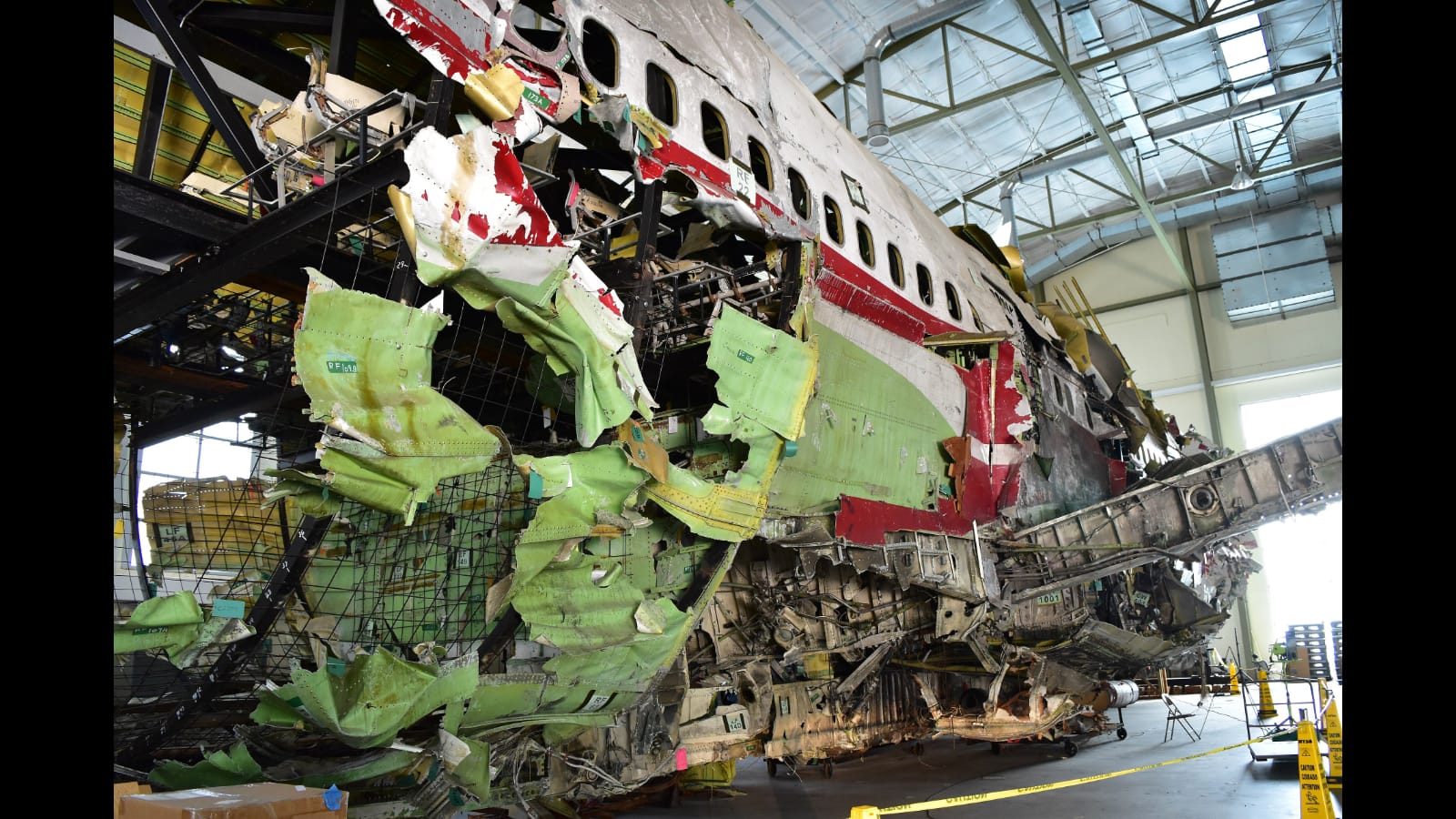
In the year 2000, the NTSB released its report on the TWA Flight 800 case. It laid out, very exhaustively, the absolutely conclusive evidence that it was caused by a spark igniting a volatile fuel-air mixture in the center wing fuel tank, and explained why there was no evidence whatsoever of a missile or bomb explosion. I didn’t read the report at the time but I saw plenty of press coverage about it on the internet. I remember feeling angry. I thought, “They got it wrong again! They’re covering up that terrible thing that could’ve killed Charlie.” I recall reading some coverage of the report on my computer late at night, right before I went to bed. While I was lying in bed, before falling asleep, I silently fumed about what I thought was the erroneous report.
Then, suddenly, I had an epiphany. I thought, “Wait a minute. I’m feeling angry because the investigators concluded that my friend was not almost murdered?” I realized what a perverse emotional reaction this was, and how misguided. Then the intellectual aspect of it kicked in. I hadn’t even read the report. I had no idea what the evidence actually was. All I heard was the “streak of light” claims, news reports about what Pierre Salinger had said in 1996, and a few other unsourced statements on the internet. I should’ve been happy that, if Charlie had indeed been killed in the incident, at least there was a significant chance that it wasn’t an act of terrorism or accidental murder. I went to sleep feeling deeply ashamed of my initial reaction. With all my education and experience, I should have known better than that.
This was the beginning of my climb out of the conspiracy rabbit hole—not just about TWA Flight 800, but about everything.
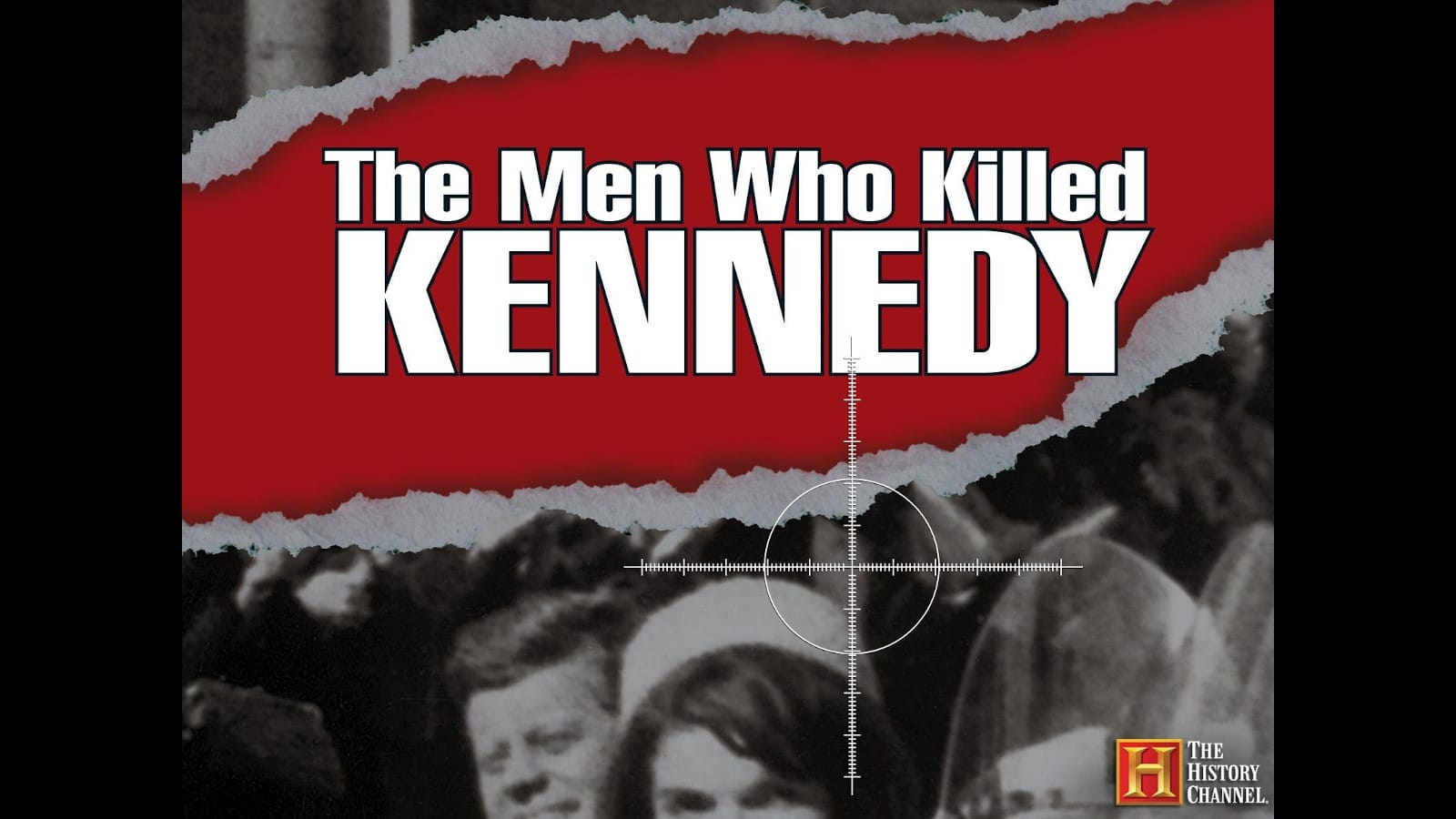
Not much longer after that, I rented, from Blockbuster Video—this was the year 2000, remember—the tape of the infamous British-made pseudo-documentary film The Men Who Killed Kennedy, made in 1988. I associated it obliquely with the TWA 800 event because during that summer it happened, 1996, I had first been exposed the History Channel (without yet knowing how terrible it was), and they reran the series, one of their most popular shows at the time. When I re-watched the show for the first time in four years I was singularly unimpressed. The claims seemed a little far-fetched and hokey, and they were also inconsistent. (Wait, it was the Corsican Mafia and the CIA?) At one point in the show I watched someone who claimed to be a medical professional describing the wounds to Kennedy’s head and showing them on a diagram presented on-screen. The way he was describing the wounds was not consistent with the diagram, which showed them in a totally different configuration. It was a very subtle discrepancy but it stuck out in my mind immediately. I thought, “Hey, wait a minute. I don’t think that guy knows what he’s talking about.”
I didn’t even finish the show. I immediately turned off the TV, went to my computer and searched for information on The Men Who Killed Kennedy. Within minutes—on a 2000-era dial-up connection—I found a plethora of sites containing detailed debunkings of the show, which was so egregiously misleading and fraudulent with its assertions that, even before it aired for the first time on British television in 1988, the government of the UK required its producers to air it with a disclaimer and also to make a follow-up show addressing the inaccuracies. The Men Who Killed Kennedy was complete garbage, one of the smelliest offenders in the fetid stinking pile of JFK conspiracy offal.
Within a few days of this incident I began reading actual documents and scholarly sources about the assassination of Kennedy. It couldn’t have been more than four days before I completely changed my long-held belief. It clearly was not a conspiracy. The evidence was quite clear that Lee Harvey Oswald had acted alone. Everything I’ve read in the 20+ years since that time has led me to that same conclusion, and of course if you know my YouTube channel you probably know something of my history with that subject.
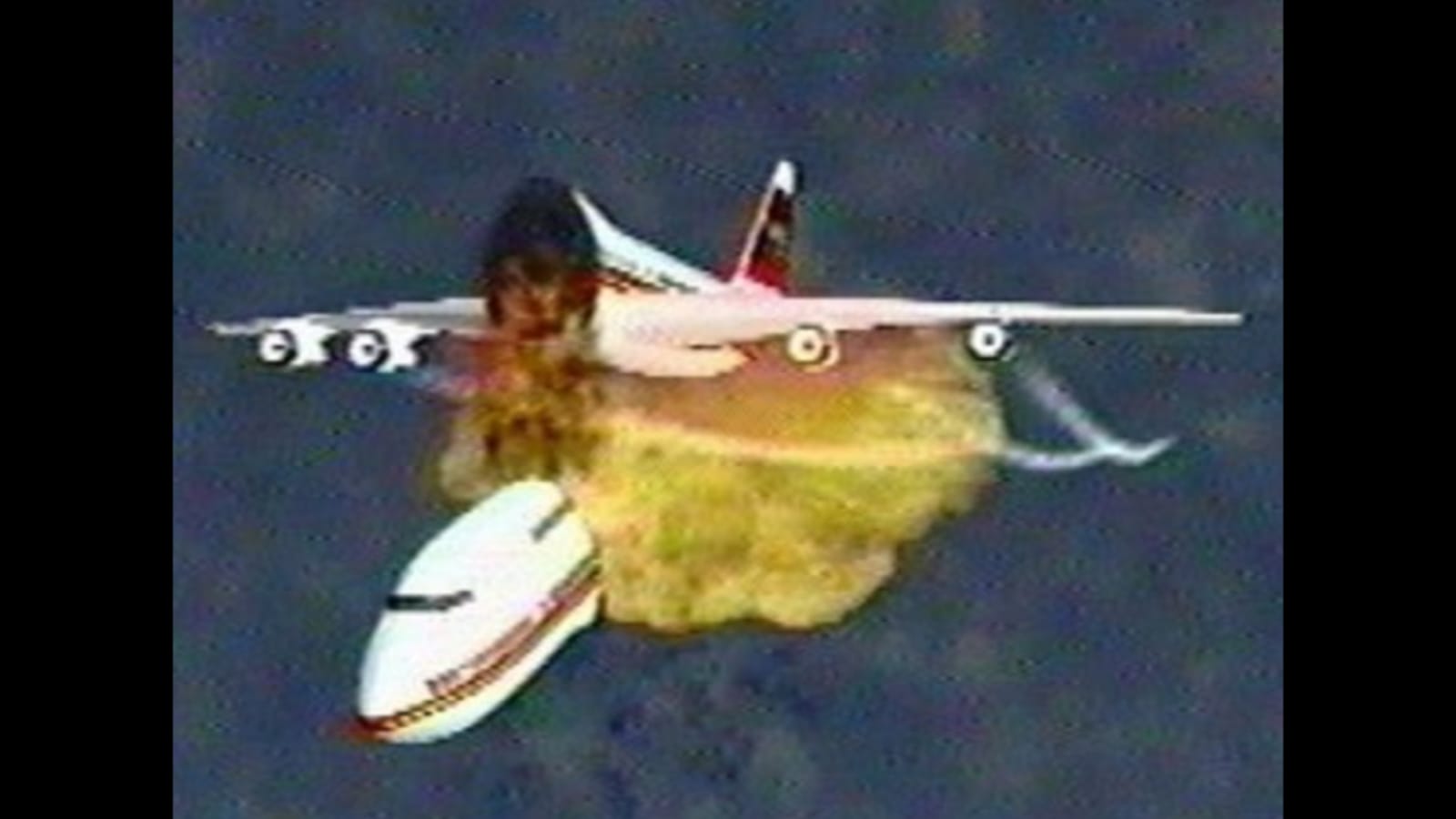
That same week I also obtained and read a copy of the NTSB report on TWA Flight 800. The exact same thing happened as with the Kennedy case: when I actually sat down to read the documents and parse the evidence for myself, it became crystal clear that the conspiracy beliefs I’d previously held—which I deliberately did not challenge by looking deeper into the subject—were totally untenable. The report even addressed the “streak of light” stuff, which the NTSB and the Navy proved, in a series of missile test-fires under similar conditions as existed around Long Island on the night of the tragedy, was totally inconsistent with what the witnesses would have seen if a missile had destroyed TWA Flight 800. And the exhaustive reconstruction and analysis of the debris indicated there was no physical evidence of a bomb or missile detonation. TWA 800 was destroyed by the explosion of the center fuel tank. It was a tragic accident. It just was. Had Charlie died that night, it still would’ve been tragic and needless, but it would not have been a murder or a cover-up.
This is the punch line of my TWA Flight 800 story, but there’s a post-script to it as well. In 2023, shortly after my YouTube channel started to become popular, someone who appreciated my videos contacted me. He said he’d been researching TWA Flight 800 for many years and wanted me to host a podcast with him about it. Naturally, he believed it was a conspiracy, that it was shot down, and that his podcast would “expose the truth” on “a huge cover-up” that had lasted nearly 30 years. He kept repeating, “I hope this can become a movie!” (Tellingly, he did not speak in terms of hiring me to do this work; I think he expected I’d sign on to his passion project for free). Perhaps uncharacteristically of me, I did not try to disabuse him of his conspiratorial notions by asserting the truth—perhaps I should have—but instead just politely declined to be involved. This person did not take no for an answer. He responded petulantly and gave reasons why I should join his podcast project. If you tell someone “Sorry, I’m not interested,” and then the person tries to argue with you about why you should be interested in their pet project, this is a very big red flag. Indeed, over a few more emails, none of which I answered, this person began describing his psychic “visions” of TWA 800 in which he pictured himself flying behind it and witnessing the event firsthand, etc., etc. And again he repeated, “I hoped it could be a movie!” Not only did I not respond, I blocked his address. From his previous messages he sounded as if he was mentally unstable.
That incident made me more sad than angry. Here it is, nearly 30 years after this devastating and accidental tragedy, and some people are so fixated on fantastical conspiracy notions surrounding it that they’ve devoted significant chunks of their lives to flogging these false notions to random strangers they encounter on the internet. There was a time when I wanted to believe in those kinds of notions, and did strongly, or at least with the appearance of strong belief when in fact my understanding of the subject was shallow and ignorant. I’m older now and a lot wiser. The TWA 800 tragedy, awful as it is, helped make me a better and clearer thinker, and ultimately a much better historian. Every person who dies in an accident by definition dies for nothing. But there are still positive lessons we can take from terrible and heartbreaking events like this one. This was my story of having learned such a lesson, for what it may be worth.
The Value Proposition
Why should you be reading this blog, or receiving it as a newsletter? This is why.
☕ If you appreciate what I do, buy me a virtual coffee from time-to-time to support my work. I know it seems small, but it truly helps.
📖 You could also buy my newest book.
🎓 Like learning? Find out what courses I’m currently offering at my website.
📽 More the visual type? Here is my YouTube channel with tons of free history videos.



Comments ()