Historic Painting: “The Choice of the Bride” by Konstantin Makovsky, 1886.
This beautiful picture depicts a bride show in the 17th century, whereby a Tsar chose his consort.
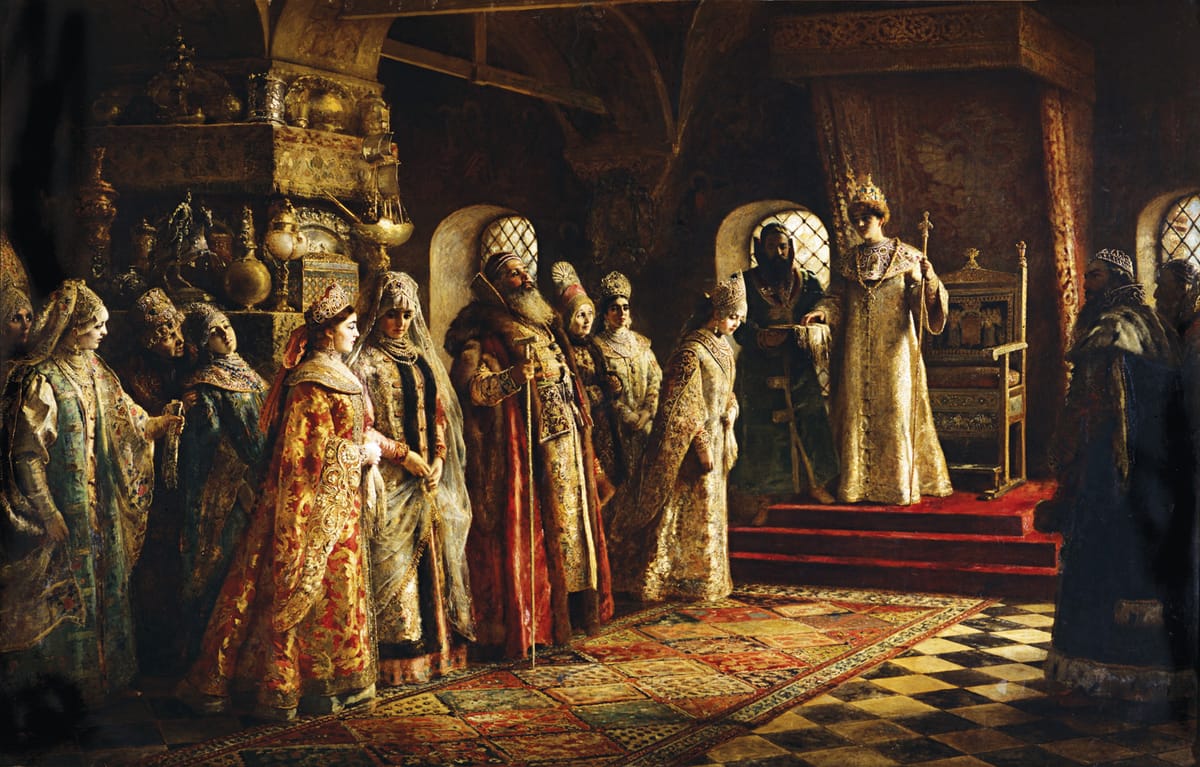
This lavish and romantic historical painting depicts the early 17th century, but is obviously a product of the late 19th. In this picture, sometimes known as “The Bride Show,” Tsar Alexis I examines a host of beautiful ladies, carefully chosen by the nobles and religious leaders of Russia, to determine which one he wants to marry. Though the scene is idealized here, it is obviously intended to depict a real event that occurred in 1647, when the young ruler was 18 years old. The Tsar ultimately chose Maria Ilyinichna Miloslavskaya, a beautiful woman who eventually became the mother of two future Tsars, Feodor III and Ivan V. Maria died in childbirth in 1669; Tsar Alexis ruled until his death in 1676.
“The Choice of the Bride” is clearly a romantic-era painting, and has a touch of nationalism; the two were often combined in mid-19th century art. The picture also has a look of Orientalism, another art style popular at the time. The artist, Konstantin Makovsky, sought to take the viewer back to an idealized past in which Russia was glittering, exotic and beautiful, the true glory days of an empire that was then, in the 1880s, in a precipitous decline. Indeed, just a bit more than 30 years from revolution, late Imperial Russia was the time to reimagine the past as romantic and bold, where it could just as easily have been recalled as brutish, dank and cold (which is probably much closer to the way it really was in 17th century Russia). Yet you see none of that here. The gowns are beautiful, the brocaded carpets rich and deep, the young Tsar looks both handsome and wise, and the bearded nobles look stately and loyal. This is definitely one vision of Russia’s past, but one marked with certain political and cultural baggage of the time in which it was created.