Historic Painting: “Giant Steamboats at New Orleans” by Hippolyte Sebron, 1853.
A French painter turns his eyes and brush toward the romantic riverboat era that flourished before the Civil War.
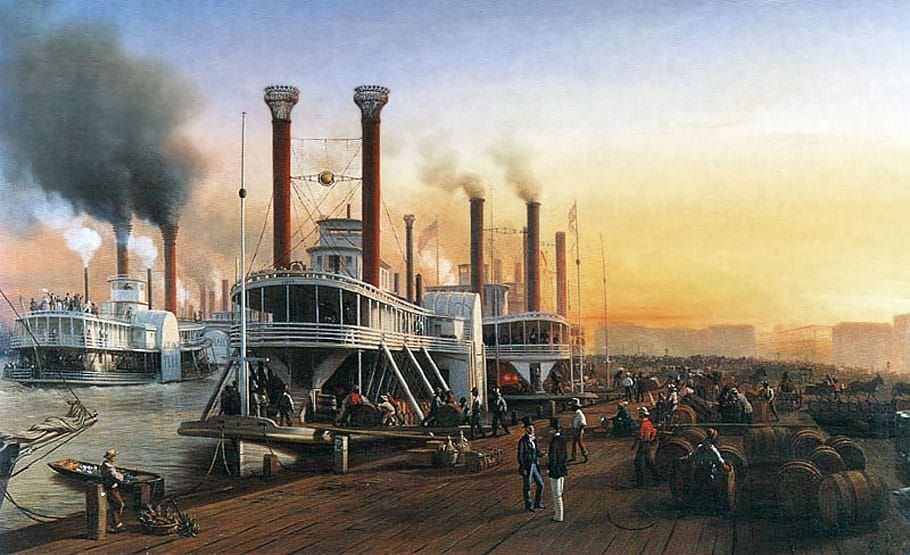
This wonderful painting instantly captures the romance and history of a vanished era. Double-stacked paddle-wheel steamboats, looking like big chunks of wedding cake, crowd a Mississippi River dock. There’s lots of commerce: barrels being loaded and unloaded, horse-drawn carts going by in the distance, and two top-hatted gentlemen, perhaps discussing business, in the foreground. Some of the people in the background and hanging around on the docks are African-Americans, probably slaves. There’s an environmental aspect of this picture too, with the hazy dusk sky and clouds of steam and coal smoke blanketing the waterfront. This could only be from the time shortly before the U.S. Civil War, the “riverboat era” that was quite fetching and romantic, but which also, with its undercurrents of slavery and economic exploitation, undoubtedly had a dark side.
This very American of subjects, called appropriately Giant Steamboats at New Orleans, was painted in 1853 by a Frenchman, a fellow with the bizarre name of Hippolyte Sebron. I featured a picture by him before in this series, back in the early days of this blog; can’t believe it took three years to get around to another of his works. Sebron had relocated to America temporarily after a number of his paintings were destroyed in a fire connected with the Revolution of 1848 in Paris, and an incident involving his former partner, Louis Daguerre, who developed a type of early photography called the Daguerreotype. Sebron was obviously attracted by romantic settings, often urban in nature. I find it fascinating how he could interpret an American scene like this with the classic eye of a European romanticist, and that’s what I think makes this painting so interesting.