Behind the Scenes: Millard Fillmore, The Conspiracy Theorist President.
My latest video profiles the strange life and odd beliefs of the 13th U.S. President.
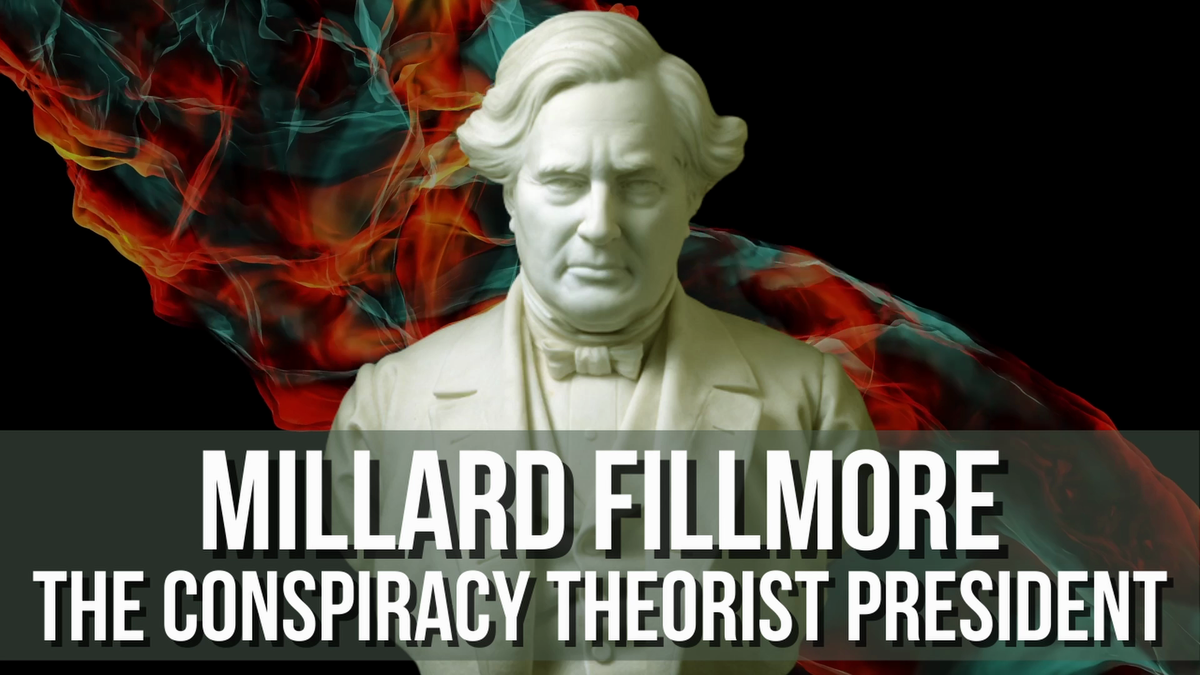
I can hardly believe it’s time again to do another companion article on a YouTube release on my channel. Yesterday (March 29, 2026), “Millard Fillmore: The Conspiracy Theorist President” went up. As is now customary, I thought I’d say a few words about the video, what I hoped to accomplish with it, and the process of making it. I consider these articles a sort of debriefing once I’m done with a large video project, and part of the official process of moving on to the next one.
The video itself is embedded below.
Millard Fillmore, the 13th President of the United States, is, you could say, infamously obscure. Almost any American who knows his name—which isn’t many—is likely to know it only because it was presented as some sort of trivia question, with chances being good that “Who’s the most obscure President in American history?” was the question. I had lunch recently with someone who asked what the subject of my next video was, and when I said the infamously-obscure name, he looked at me blankly and said, “I’ve never heard of that person.” Coming to the White House as an accidental President, upon the sudden and unexpected death of Zachary Taylor in early July 1850, Fillmore was undistinguished even by the standards of the time, where chief executives were expected to take a back seat to Congress and were rarely subjects of press coverage outside of purely political circles. It’s easy to get the sense that even the authors of American history books would ignore him completely if they had a choice. Consequently, in-depth coverage of Fillmore or his presidency is very rare.
Fillmore’s main contribution to history was signing the Compromise of 1850 into law. Taylor’s death, from gastroenteritis he developed after overindulging probably contaminated fruit or water at a Fourth of July celebration, changed the game on a package of legislation that was then working its way through Congress. The Compromise, which historians do often spend time on, was intended by its principal author Henry Clay (Senator from Kentucky) to be more or less the final settlement of the issue of slavery in the United States, particularly whether it would be allowed in territories the U.S. had recently plundered from Mexico. Taylor had been opposed to Clay’s version of the compromise. Fillmore, as Vice-President, was generally excluded from Taylor’s inner circle and had no impact on policy. But he’d told his chief that if it were up to him, he’d sign it. That’s precisely what the “black swan event” of Taylor’s death led to. It’s also chiefly the reason why Fillmore isn’t generally regarded as a strong or even competent President.