Behind the Scenes: Canberra, Liner Too Late.
A new, much shorter video on my channel profiles the famous P&O liner that sailed to Australia for over 30 years.
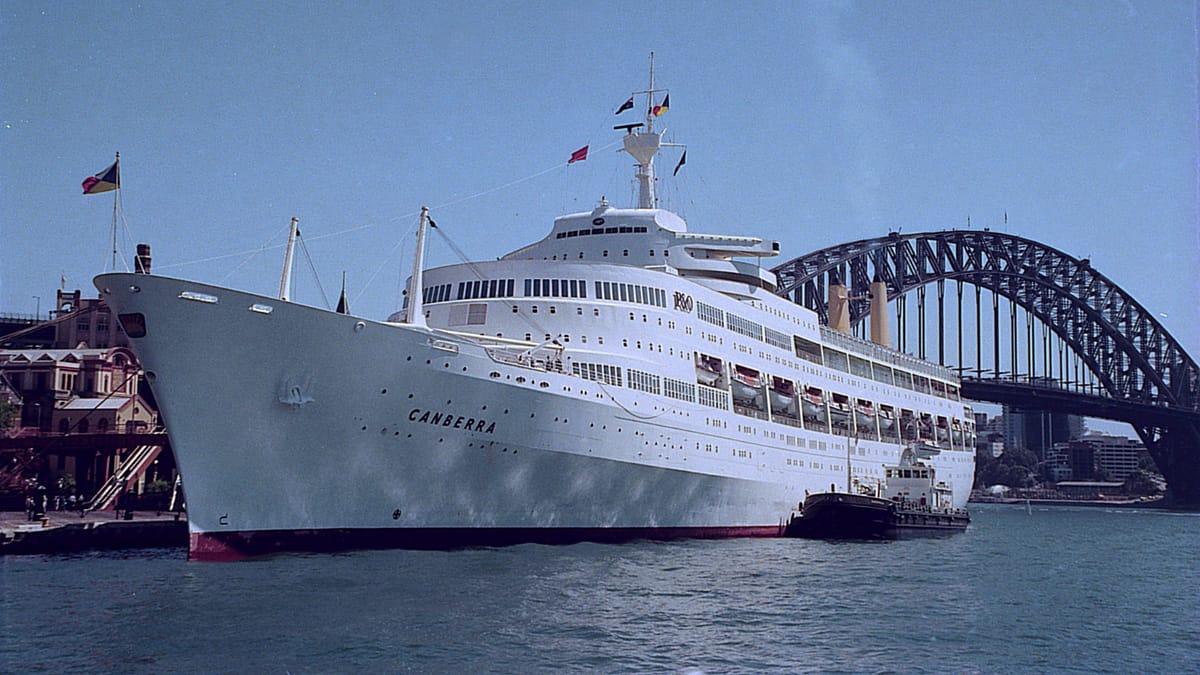
This will be a short one because the video it’s about is what I call a “shortie,” only 31 minutes—a marked departure from my usual 2½ to 3-hour deep dive videos. But yes, a new video, called “Canberra: Liner Too Late,” went up on my channel yesterday, March 8. As usual I’ve embedded it below. This video is a throwback to the old format I used to do on my channel, back in 2021 and ‘22, when I did many shorter videos focusing on ships and nautical subjects, particularly ocean liners. If you’ve read my articles for any length of time you know I’m quite fascinated by ocean liners, so Canberra was probably an inevitable subject that I’d get to on my channel sooner or later.
Canberra, which made her debut in 1961, was for a long time the flagship of P&O (Peninsular & Orient) Lines, the British shipping company that literally helped build the British Empire. The concept behind the ship was to carry settlers from the British Isles and elsewhere in Europe to Australia and New Zealand in the decades immediately after World War II. This was a time when the Australian government was heavily encouraging and financially subsidizing immigration voyages, for both political and racial reasons. Australia’s experience in World War II, being uncomfortably close to the conquests of the Japanese, and the postwar obsession with checking Communism—which was sometimes seen in racialized terms, especially after Communists took power in China in 1949—led to this policy. But Canberra also came from the tradition of the great ocean liners, many of them on the Atlantic. P&O hoped to bring transatlantic-style luxury, speed and comfort to the much longer passage between Europe and Australia, and also around the Pacific Rim. Indeed, when she first came on the scene in 1961, Canberra was a sensation and was well-loved by passengers on multiple continents.