A thousand points of denial: The global warming legacy of George H.W. Bush.
Despite his successes, Bush's most important and enduring legacy is one of failure: the failure to lead on the issue of climate change.
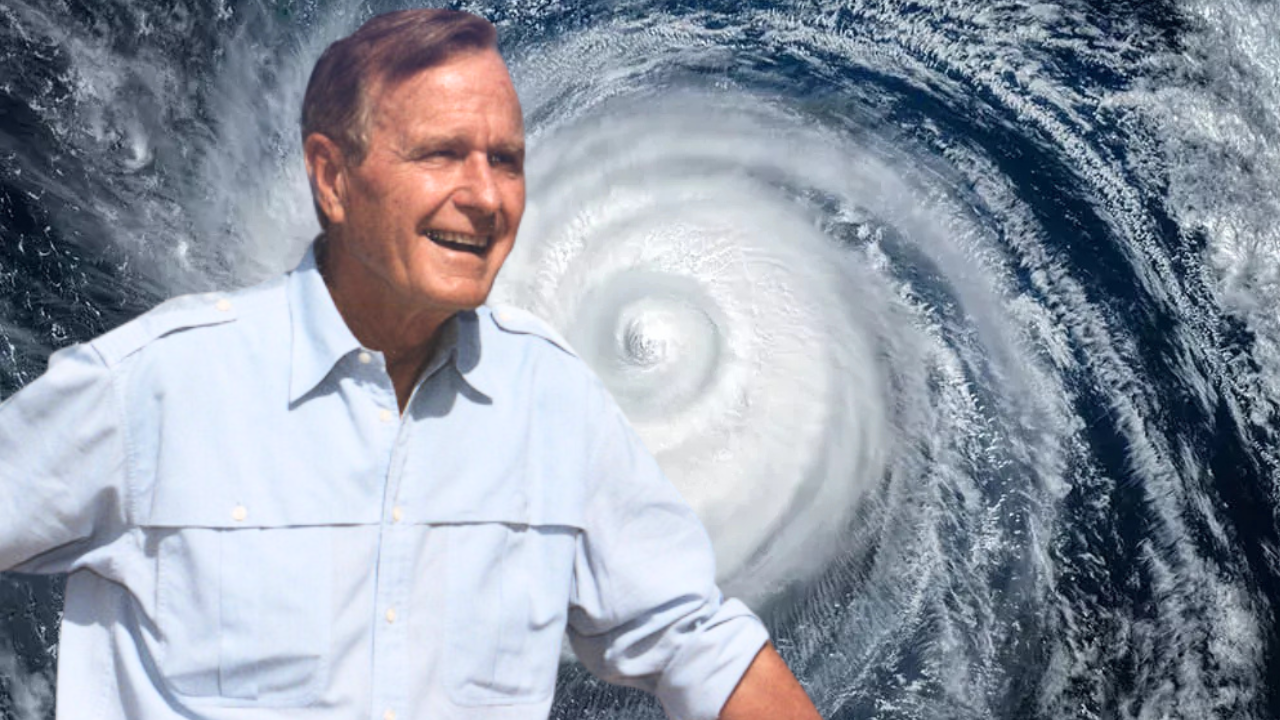
Seven years ago today, on November 30, 2018, former President George H.W. Bush died peacefully at the age of 94. I believe that Bush was a good man with good intentions, and there is much to admire about his life and accomplishments, particularly his military heroism in World War II. But assessing Bush’s historical legacy in a rational and cogent way means taking stock of his failures as well. What hasn’t been discussed very much in the historical memory of the first President Bush—at least in comparison with things like his foreign policy achievements or leadership during the first Persian Gulf War—is Bush’s legacy on climate change. I would venture to say that no other President has had a greater impact on the issue than Bush did, which is even more remarkable considering he served only a single four-year term. Unfortunately, that impact is almost entirely negative. Bush was the first President to entrench climate denialism as official government policy. As the terrible effects of global warming get worse every year, we’re still reaping the bitter results of what may come to be remembered as Bush’s single biggest mistake in office.
This failure is touched with irony because Bush himself was apparently not a denier, or at least he was not one at first. Few remember this, but during his 1988 campaign for the presidency Bush made global warming an issue. He made a number of promises regarding the environment, and specifically mentioned global warming—it was most commonly referred to the “greenhouse effect” or the “greenhouse problem” at that time—as an issue that the United States would tackle under his administration. Once in power, though, this promise was quickly forgotten. In the early days of his administration, a veritable flood of letters, studies and position papers mostly from industry-funded groups like the deceptively named Global Climate Coalition flowed into the Bush White House, all either trying to shed doubt on the undeniable scientific consensus on human-caused global warming, or to urge the government not to take any action to address it. This appears to have been a deliberate attempt to crystallize the Bush administration approach to global warming as soon as possible after Bush’s inauguration, and set denialism as the default position, privately if not publicly.
The period 1988-89, when Bush was running and just taking office, was the turning point for climate change denialism. Though it seems hard to believe today, denial of the proven scientific fact global warming or its (also proven) human causation was not really a thing before that time. The facts were well-known and uncontroversial. Beginning in the 1970s, even major oil companies like Exxon and Shell had in-house scientists extensively researching the phenomenon, and their leaked documents prove that their executives to the highest level knew and accepted the facts of global warming and their role in causing it. Yet sometime in the late 1980s, the oil majors made a deliberate decision to begin muddying the waters of public discussion about climate change, funding elaborate PR campaigns to inject doubt about the phenomenon into the public mind. Many of the selfsame consultants who had worked for tobacco companies on the effort to deny the link between cigarette smoking and lung cancer were reborn as fossil fuel industry mouthpieces, quacking trite denialist talking points that deliberately and egregiously distorted the facts. This public campaign coincided with a less visible one to influence government policy to ignore the issue. Sadly, these efforts paid off in the new Bush administration.
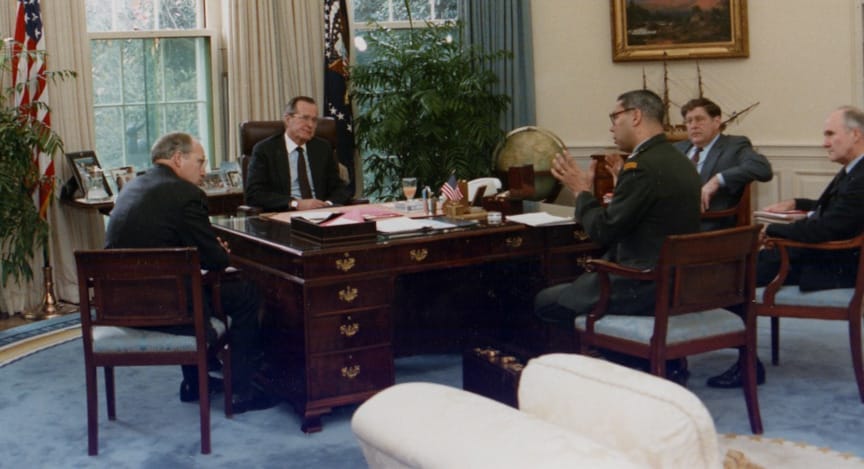
Bush’s environmental policy was a schizophrenic one. Though his administration did secure passage in 1990 of important amendments to the 1963 Clean Air Act, which included regulations that successfully ameliorated acid rain, these issues were basically the equivalent of the low-hanging fruit. Bush was mostly disengaged on this, as well as most domestic policy matters. As a result, responsibility for environmental issues was laid primarily into the hands of his chief of staff, John H. Sununu. Sununu’s sole preoccupation was political optics: he sought to give Bush as much credit as possible for environmental progress while actually doing as little as possible. And Sununu himself was (and remains) an arch global warming denier. I have personally studied documents from the Bush Presidential Library involving Sununu’s role in climate change policy, and they bear out that at every turn Sununu tried to water down scientific conclusions, magnify statements of uncertainty, and “preserve flexibility” in negotiating with other countries on climate change. Usually that translated into refusal by the United States to commit to meaningful reductions in CO2 emissions and trying to scuttle any international agreements that would have that effect.
Sununu’s rampant denialism had immense repercussions, even after Sununu himself was cashiered in December 1991 after a scandal involving the wasting of public money on private travel perks. In 1992 Bush made a big show of attending what’s usually remembered as the “Earth Summit” in Rio de Janeiro, out of which came the United Nations Framework Convention on Climate Change, the first international climate change treaty. While Bush didn’t oppose that treaty—which was ratified only weeks before he was defeated for re-election by Bill Clinton—he did refuse the Convention on Biological Diversity which also came out of the Rio summit, on the grounds that it would hurt the U.S. biomedical industry. The U.S. was the only nation not to ratify it. And the run-up to the UNFCCC, the major treaty, was marked by repeated attempts by American negotiators to strip out of the draft any specific CO2 emissions reduction targets—in other words, to turn the treaty into a toothless statement of aspiration and nothing more. The Bush White House personally directed these negotiations. Bush, or at least Sununu, was determined not to be a leader on climate change.
Bush’s failure to lead on global warming has proved disastrous to the world in the decades since. Genuine U.S. efforts to reach and enforce meaningful international agreements to curb greenhouse gas emissions—which would have had the effect of bolstering the economy by making the U.S. a leader in the renewable energy sector—might have led to an effective regime of climate treaties, instead of the toothless and pathetic debating society that the Conference of Parties (COP) has become. One can make an argument that the scuttling of effective climate treaties, which was a deliberate policy goal of the Bush White House, took international cooperation off the table for all time as a tool to arrest the climate crisis. Furthermore, by demonstrating leadership on global warming and bringing the Republican Party along with him, Bush probably could have prevented industry-funded denialism from metastasizing within the conservative movement and ultimately recognizing even the slightest iota of concern about global warming as a hallmark of “the enemy,” which is where we are now, especially with a notorious denialist sitting in the Oval Office today. Had Bush moved strongly on global warming in 1989, at the moment of maximum opportunity for him politically, he might today be remembered as the best climate change President, instead of one of the worst.
The most fondly remembered moment from the Earth Summit in Rio de Janeiro in 1992 was the address by 12-year-old environmental activist Severn Cullis-Suzuki. Too bad Bush wasn’t listening.
Given the high stakes involved in the climate crisis, George H.W. Bush’s dereliction of duty with regard to global warming policy has to stand as the paramount failure of his administration. I believe he was generally a moral man, and I believe he cared about people, in his way. But he simply didn’t understand what was at stake with global warming, and he fell down on the job of confronting it. That failure will continue to ripple throughout American and world history for decades to come.
This issue has been on my mind recently, not just because of today’s anniversary of Bush’s death, but because the story of his centrality to the legitimization of global warming denialism appears in my upcoming video, “The Cult of Technology: From Railroads to AI,” due out in late December 2025. Though not likely to make me any friends among the denialist crowd—who all hate me anyway—it’s my hope that inclusion of this issue in the video at least gets people thinking about why and how we’ve gotten into the terrible fix we’re in when it comes to the climate crisis. Reckoning with that is a necessary first step in figuring out how, if at all, we can get out of it.
The Value Proposition
Why should you be reading this blog, or receiving it as a newsletter? This is why.
☕ If you appreciate what I do, buy me a virtual coffee from time-to-time to support my work. I know it seems small, but it truly helps.
📖 You could also buy my newest book.
🎓 Like learning? Find out what courses I’m currently offering at my website.
📽 More the visual type? Here is my YouTube channel with tons of free history videos.



Comments ()